

From fabrication and robotic welding to digital assembly and end-of-line testing, Godrej’s Khalapur facility reveals how a forklift takes shape, writes Upendra Kasbekar.
A finished forklift looks deceptively simple. Four wheels, a mast, forks, an operator station and a counterweight make up the machine that most users see. But behind that familiar form is a manufacturing journey involving steel, fabrication, welding, painting, hydraulics, electronics, software, quality checks and hundreds of individual assembly decisions.
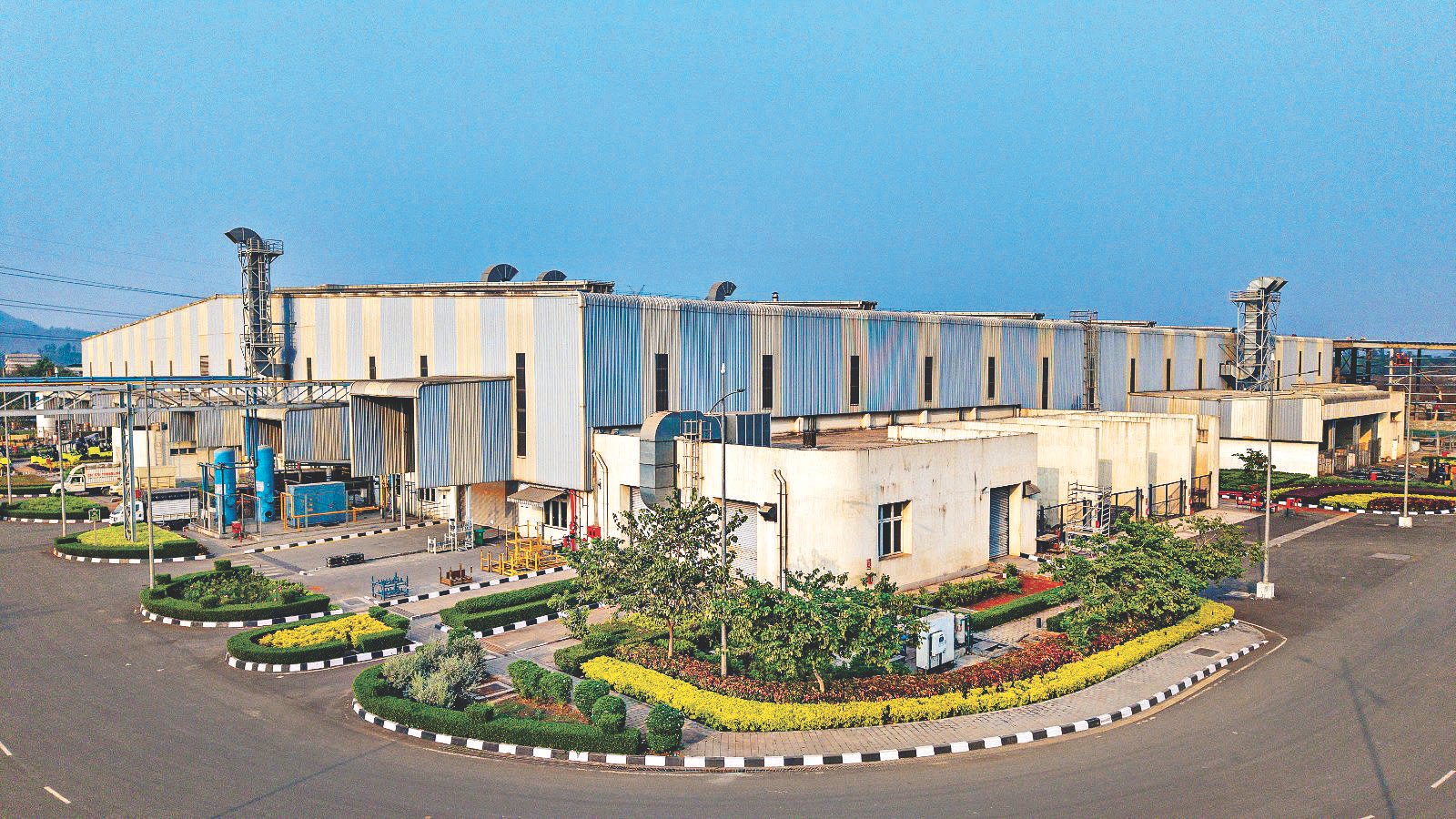
At Godrej Enterprises Group’s newly commissioned Material Handling Equipment (MHE) manufacturing facility at Khalapur, Maharashtra, that transformation can be followed almost step by step.Located within the 360-acre Naoroji Godrej Industrial Park, the facility is designed not merely as another production location, but as a manufacturing ecosystem built around automation, digitalisation and traceability. Spread across 1.7 lakh sq. ft. of current floor space, with another 34,000 sq. ft. under construction and 2 lakh sq. ft. reserved for future expansion, the plant currently has an annual production capacity of 6,000 units, scalable to 15,000 units as demand grows. For a material-handling industry increasingly influenced by warehousing, e-commerce, manufacturing and supply-chain expansion, the significance of the facility lies not only in how many forklifts it can produce, but in how they are being produced.
Starting Material
The journey of a forklift begins long before the finished machine reaches a warehouse. Inside a manufacturing plant, material has to be converted into components with the dimensional accuracy and consistency required for a machine that will eventually lift and move heavy loads. Fabrication therefore becomes one of the most important stages of the process. At Khalapur, automation has been introduced into critical welding operations, particularly for electric forklift and articulated-truck chassis. Dedicated robotic welding cells handle chassis welding, while automated sub-assembly and final-welding processes reduce dependence on manual intervention and improve consistency. The scale of this transformation becomes apparent in the articulated-truck line. According to the company’s media fact sheet, automation has increased output from less than one chassis a day to two, with headroom to reach four. The line has a monthly capacity of roughly 50 units. This is not automation for the sake of replacing manual work. It is about controlling repeatability in a manufacturing process where dimensional accuracy and weld consistency directly influence the quality of the finished machine.
That distinction is important for the MHE sector. A forklift operates in environments where reliability is critical, and the manufacturing process must therefore be capable of producing consistent machines rather than relying heavily on individual variation.
Building Structure
Once structural components are prepared, welding becomes the point where individual pieces begin to become recognisable machine assemblies. The robotic cells at Khalapur are designed to handle repetitive and critical welding operations, while the broader manufacturing system connects production activities digitally. This is where the facility’s Industry 4.0 approach becomes more than a technology label. The plant is designed around digitally connected operations, production traceability and intelligent manufacturing systems. Instead of treating automation, quality control and digital systems as independent upgrades, the facility connects them into a single production ecosystem. For Godrej, this approach is also linked to the changing requirements of its customers. Anil Lingayat, Business Head – Material Handling Equipment Business, Godrej Enterprises Group, describes the facility as a step towards strengthening India’s manufacturing ecosystem. “The facility combines advanced automation, digital manufacturing and indigenous engineering to deliver world-class solutions for a rapidly evolving logistics landscape,” he says.
The statement captures an important shift in India’s MHE industry. As warehouses become more sophisticated and supply chains demand faster movement of goods, the equipment supporting these operations also has to become more reliable, precise and adaptable.
The Paint Stage
After fabrication, the structure begins to take its final form through the paint process. Khalapur’s paint shop uses a highly automated, near-factory-length paint line with robotic application. The facility currently has the capacity to paint around 500 forklifts a month, with the system designed to scale to 1,200 units with minimal modification. The paint process is also an example of how manufacturing efficiency and sustainability can overlap. The facility uses lead-free paints and has moved away from water-intensive treatment processes through dry paint booths. According to the company, this can save up to 50,000 litres of water a day.
Automation also provides a more consistent application of paint while reducing consumption. Godrej says robotic painting lowers paint consumption by around 30 per cent per truck. Energy consumption has also been addressed within the paint process. The plant’s paint oven heat loss is maintained below five per cent, while changes that reduced equipment operating time from two hours to 30 minutes have resulted in an approximate 75 per cent reduction in fuel use. These numbers demonstrate an important characteristic of modern manufacturing: productivity and sustainability are increasingly being addressed through the same engineering intervention.
Digital Assembly
The most interesting transformation happens when individual components begin coming together.
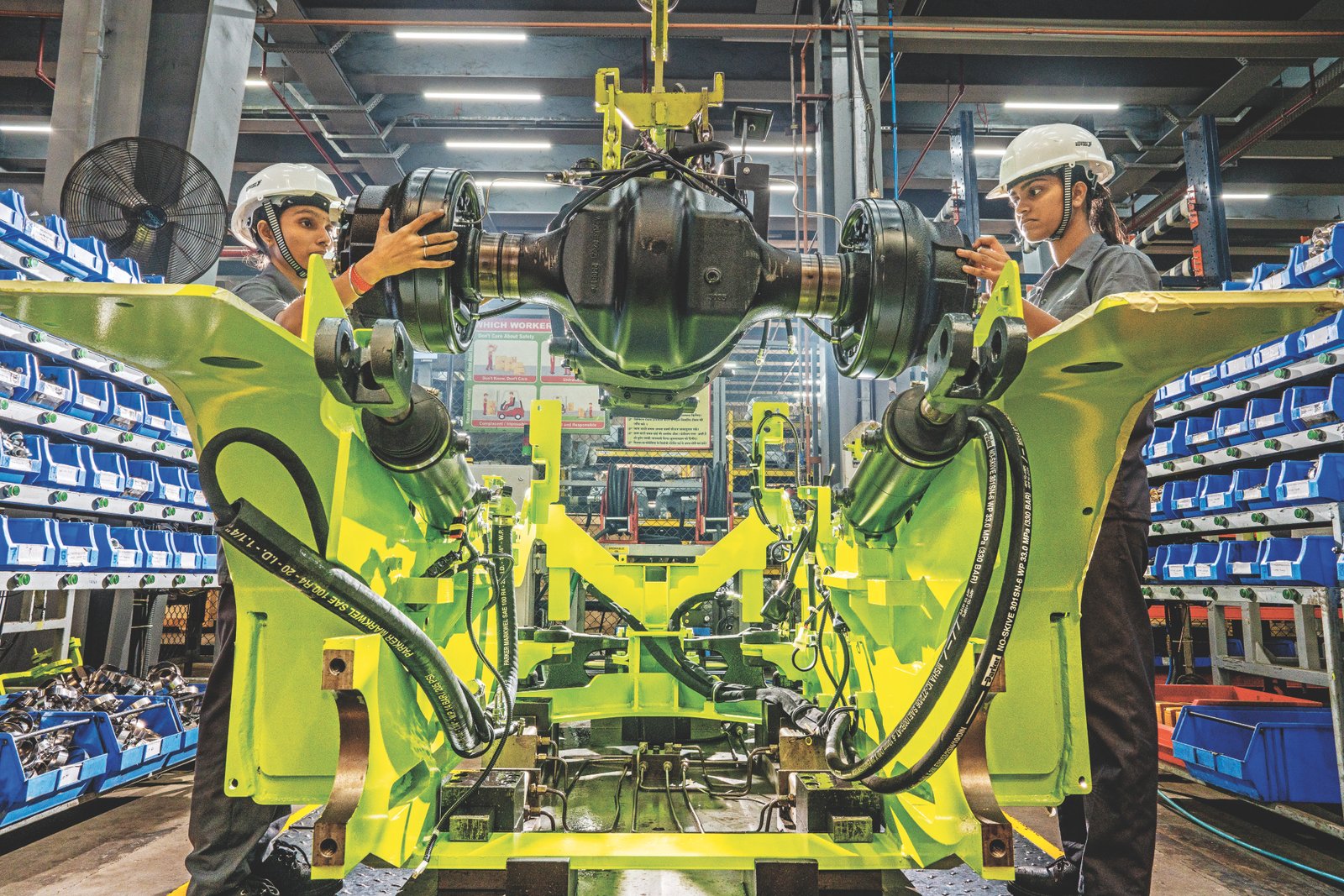
At Khalapur, assembly stations use digital work guidance, pick-to-light component selection and adjustable hydraulic platforms. Critical fasteners are subject to digitally monitored torque, creating a record that supports traceability. For a forklift manufacturer, this has an important implication. The machine leaving the assembly line is not simply a collection of components that have been fitted together. The manufacturing process can retain information about how critical assembly operations were performed. This becomes particularly relevant for equipment used in demanding industrial environments. Traceability can help manufacturers maintain consistency across machines and establish greater control over quality.
The company says the current assembly cycle for an articulated truck is between three and four hours, with a target of bringing it below two hours.That target is not simply about producing machines faster. Reducing assembly time while maintaining quality requires the production process itself to become more organised, repeatable and digitally controlled.
Testing Every Machine
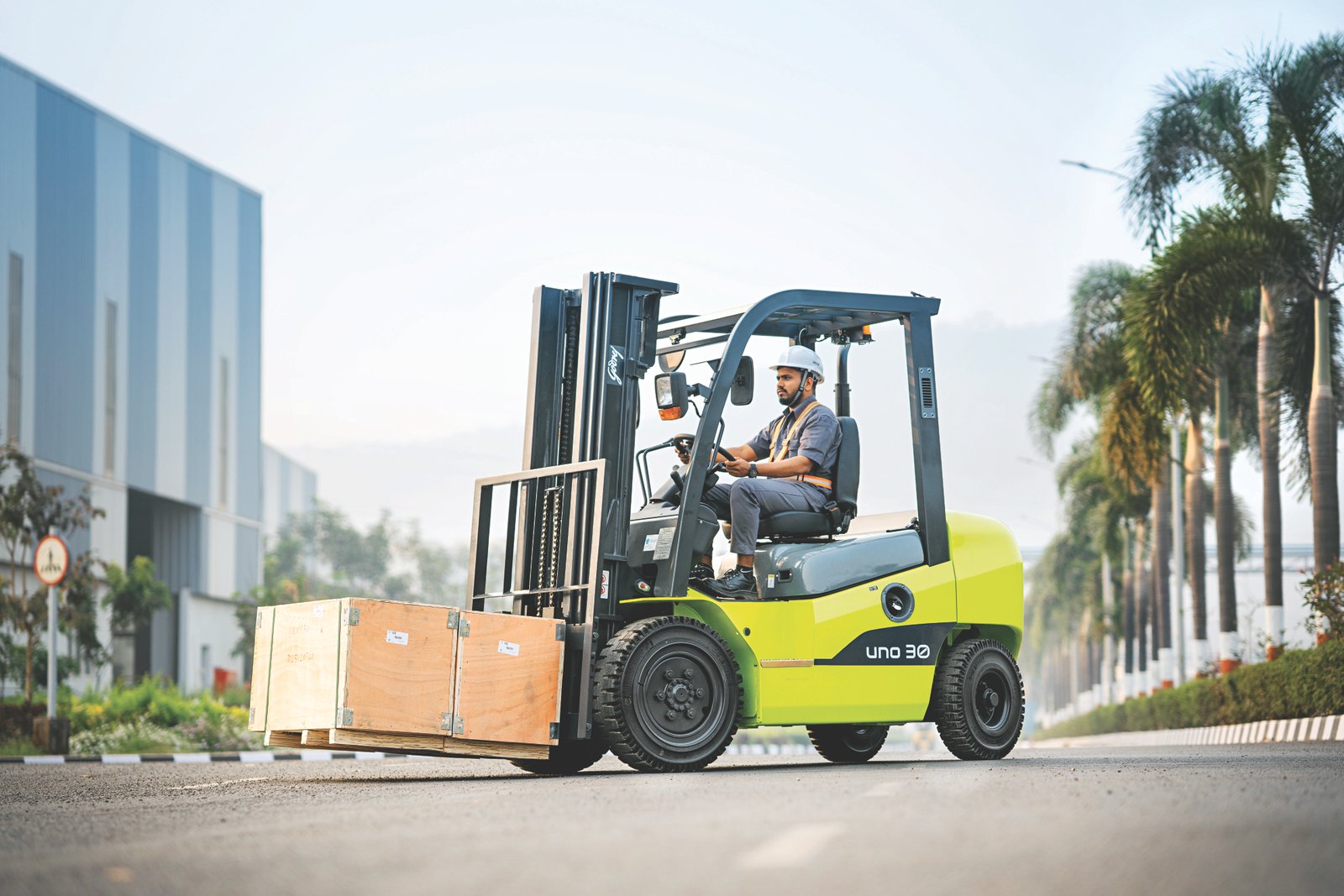
A forklift cannot leave the factory simply because it has been assembled. Before dispatch, every truck manufactured at the Khalapur facility undergoes dedicated power, brake and dynamics testing. Mast performance is also evaluated through digital lift testing for sway and drift, while UV-based systems are used for leak detection. The results of these tests are digitally captured to provide traceability. This is an important part of the manufacturing story because the final quality of a forklift is determined not only by the quality of individual components, but by how the complete machine performs as a system. Power delivery, braking, dynamics, lifting and hydraulic performance all have to work together. Testing therefore becomes the final engineering filter between assembly and customer operation. It also completes the digital thread that begins much earlier in the manufacturing process.
The Warehouse Within
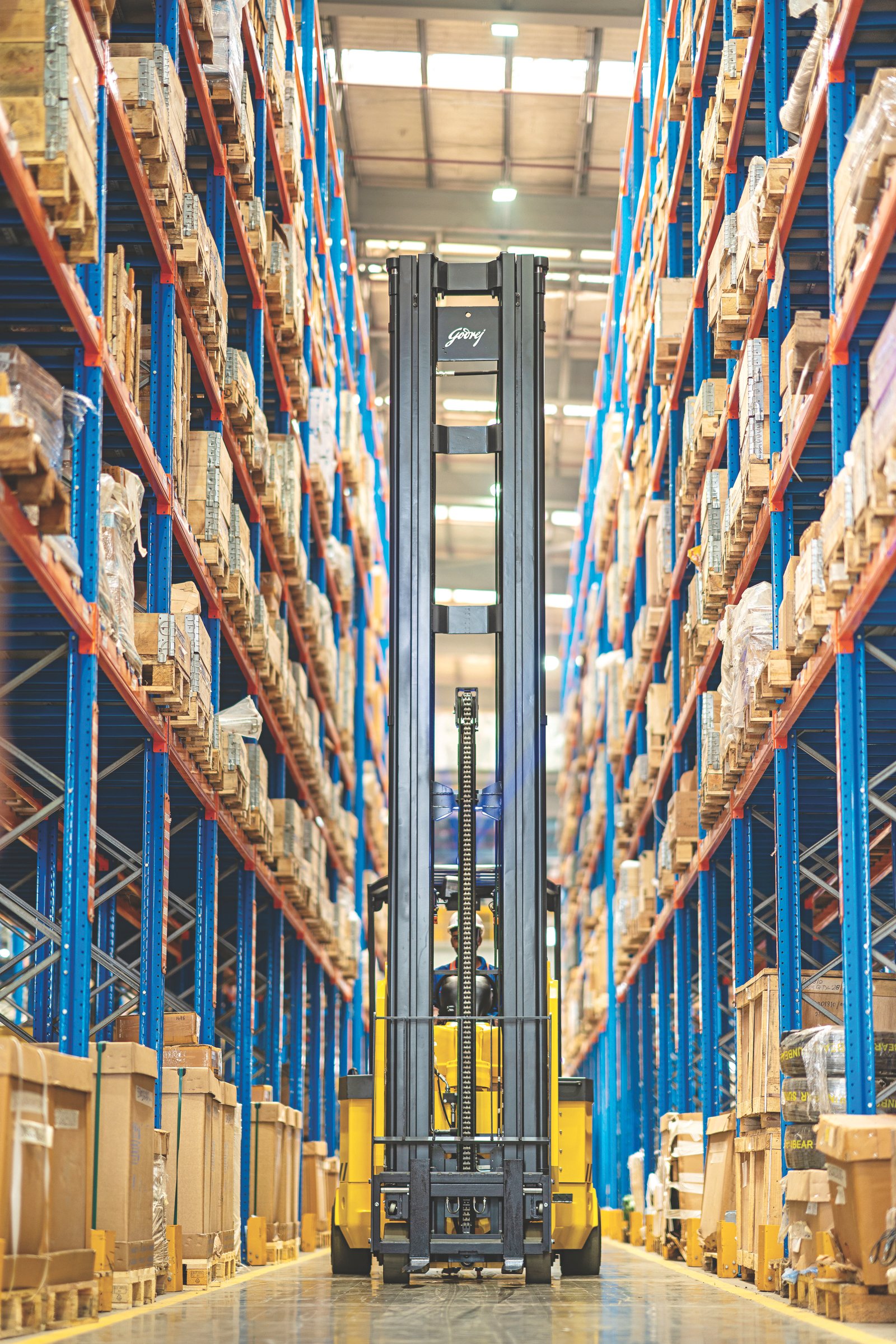
Interestingly, the plant’s own internal material movement provides a glimpse into the same logistics challenges that Godrej’s products are designed to solve for customers. The Khalapur facility includes a 50,000 sq. ft. warehouse with 11-metre rack height, 3,000 pallet positions and around 1,800 SKUs handled per day. A vertical lift module is used to compress 5,000 sq. ft. of storage into approximately 600 sq. ft. for low-frequency inventory. In effect, the factory itself becomes a demonstration of material-handling principles.Material has to arrive at the right location, in the right quantity and at the right time. Components must be available to assembly stations without creating unnecessary movement or inventory congestion. The same principles apply to the customers operating warehouses, manufacturing plants and distribution centres.
Built for Scale
The strategic location of Khalapur adds another dimension to the facility.The plant is around 70 km from Mumbai, 55 km from Nhava Sheva Port and 45 km from Navi Mumbai Airport. Its location within the wider Naoroji Godrej Industrial Park also gives the business room for expansion. With current production capacity of 6,000 units annually and the ability to scale to 15,000 units, the facility has been designed around future demand rather than today’s requirement alone. That matters because India’s material-handling market is being reshaped by several simultaneous developments. Warehousing is expanding, e-commerce and quick commerce are increasing the need for faster fulfilment, manufacturing supply chains are becoming more organised, and companies are looking for greater efficiency in internal logistics. Godrej is also using Khalapur as an export base. Its articulated trucks are exported to more than 40 countries, making consistency and manufacturing quality critical beyond the domestic market. Lingayat connects the investment to this larger economic shift, noting that “efficient movement of goods will be critical to economic growth.” He adds that the facility is intended not only to expand capacity but also to support stronger supply chains, self-reliance and priorities such as Make in India, PM Gati Shakti and Viksit Bharat.
Beyond Automation
What stands out at Khalapur is that automation is only one part of the story. Robotic welding improves consistency. Automated painting controls application. Digital assembly systems improve traceability. End-of-line testing validates machine performance. Warehouse automation improves internal material movement. But all these systems ultimately serve one objective: producing a machine that can work reliably in the customer’s environment. That is where the manufacturing story connects back to the forklift itself. A forklift operating inside a warehouse may perform thousands of movements over its working life. Its reliability depends on the strength and consistency of its structure, the performance of its powertrain and hydraulics, the accuracy of its mast and controls, and the quality of every assembly operation that went into the machine. The customer may only see the finished forklift.Inside Khalapur, however, the machine tells a much longer story. It starts with material entering the factory and passes through fabrication, welding, painting, assembly and testing. Along the way, human expertise and automated systems increasingly work together, with digital information connecting the stages. The result is not simply a forklift assembled in India. It is a manufacturing process designed to make Indian material-handling equipment more consistent, scalable and globally competitive. For an industry responsible for the movement of goods behind almost every modern supply chain, that manufacturing capability may ultimately be as important as the machine itself.