

Designed to slash crude imports and carbon emissions, India’s accelerated Ethanol blend rollout is sparking fierce debate, writes Richa Tyagi.
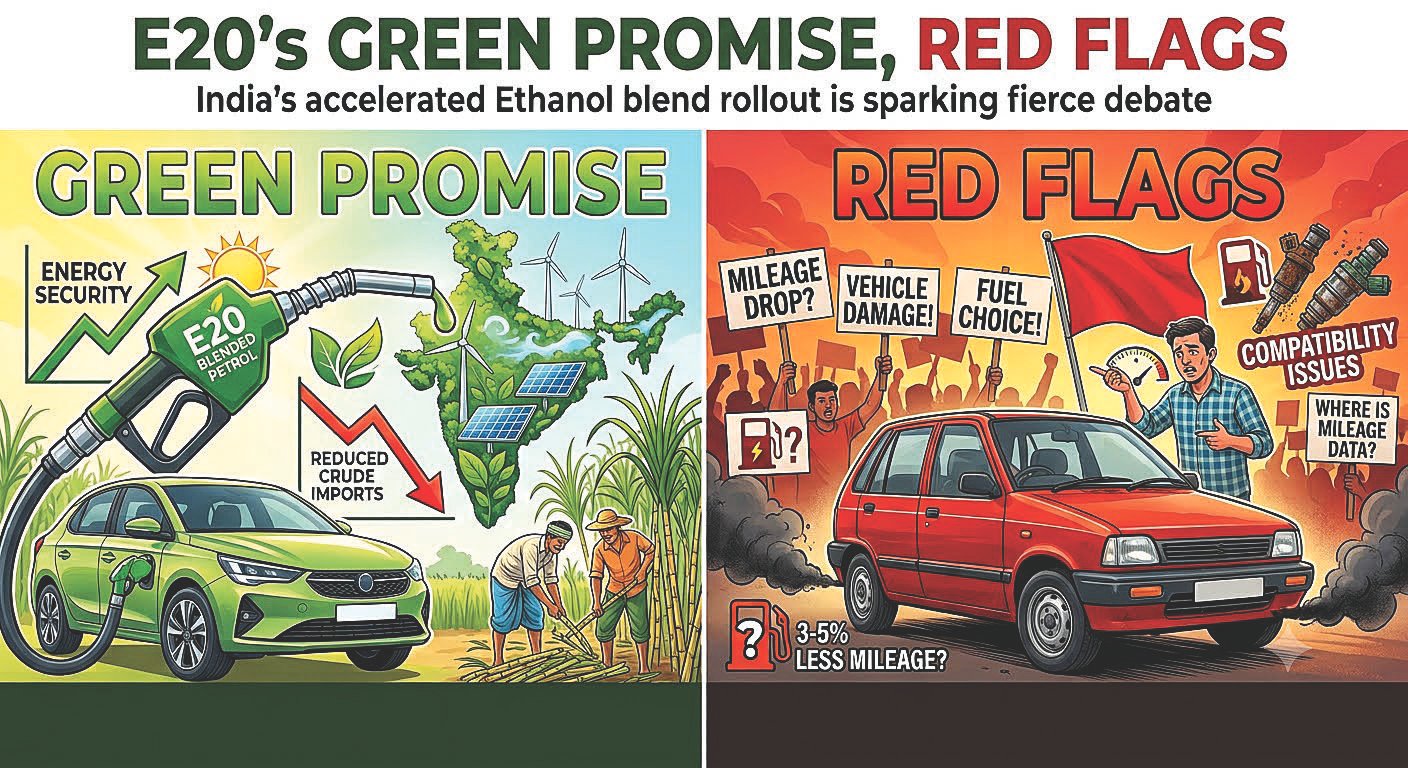
What began as one of India’s large-scale energy transition initiatives has now plateaued with consumers, automakers, component suppliers, fuel producers and policymakers putting forth their arguments. At the centre is E20-85 blended petrol. A programme rooted in the larger energy-security crude import reduction strategy prioritised to save the dollar outflow. As the Ethanol Blended Petrol (EBP) programme, launched as a pilot in 2001, has since evolved into a key pillar of India’s biofuel strategy. The original National Policy on Biofuels, 2018, envisaged 20 per cent ethanol blending in petrol by 2030. However, rapid growth in domestic ethanol production as a net sugar exporter is known to have prompted the government to advance the target to Ethanol Supply Year (ESY) 2025-26.
India subsequently achieved the 20 per cent blending milestone ahead of the original schedule. According to government estimates, the programme has, since ESY 2014-15, substituted nearly 316 lakh metric tonnes of crude oil, saved more than Rs 1.97 lakh crore in foreign exchange, and resulted in around 952 lakh metric tonnes of carbon emission reduction. More than Rs 1.66 lakh crore has also been paid to farmers through the ethanol ecosystem as per the Government data made public. Dr C.K. Jain, President, Grain Ethanol Manufacturers Association (GEMA), described ethanol as not merely an industrial success story but a national movement that connects agriculture, energy and sustainability. Placing farmers at the heart of the conversation, Dr Jain emphasised, “Agriculture remains the foundation of India’s progress.” He added that the ethanol programme is not just about producing fuel but about creating additional value for farmers, enabling the utilisation of surplus agricultural produce and crop residues to generate additional income without compromising food production.

Dr C.K. Jain, President, Grain Ethanol Manufacturers Association (Gema)

Ashwini Shrivastava, Joint Secretary, Department of Food and Public Distribution (DFPD)
Elaborating on the government’s perspective, Ashwini Shrivastava, Joint Secretary, Department of Food and Public Distribution (DFPD), discussed how the EBP has transformed India’s sugar sector. He noted that diverting surplus sugar towards ethanol production has improved the financial health of sugar mills. Shrivastava also shared that the Government released nearly Rs. 4,866 crore as sugar export subsidy during the 2020–21 sugar season, but no export subsidy has been required since 2021–22, with surplus sugar now being managed through a combination of ethanol production and exports. He also spoke about the changing feedstock mix, noting that maize contributed nearly 26 per cent of ethanol supplied during the 2023–24 ethanol supply year and accounts for around 36 per cent in the current supply cycle. It is also noteworthy that the centre has allowed imports of only raw sugar, likely to be sourced from Brazil amidst domestic price hikes. That apart, Indian farmer groups worry that imported Dried Distillers Grains with Solubles (DDGS) and potential GM feed could harm local crop prices.
The E20 debate intensified as higher ethanol blends became widely available, with consumers reporting concerns over mileage, vehicle performance and compatibility, particularly in older petrol vehicles, even as government stakeholders remained firm on their stance on a gradual validation and rollout, with OEMs echoing the sentiment.The durability of fuel-system components such as injectors, pumps and seals. Old alleged concerns raised by apex bodies like SIAM since have been reported with claimed concerns communicated to the Ministry of Petroleum and Natural Gas. These pertain to alleged component failures linked to moisture and chloride contamination in E20 fuel. The communication cited corrosion and wear in components, including fuel injectors, fuel pumps, and EGR valves. SIAM subsequently withdrew the communication, saying the data required further verification.
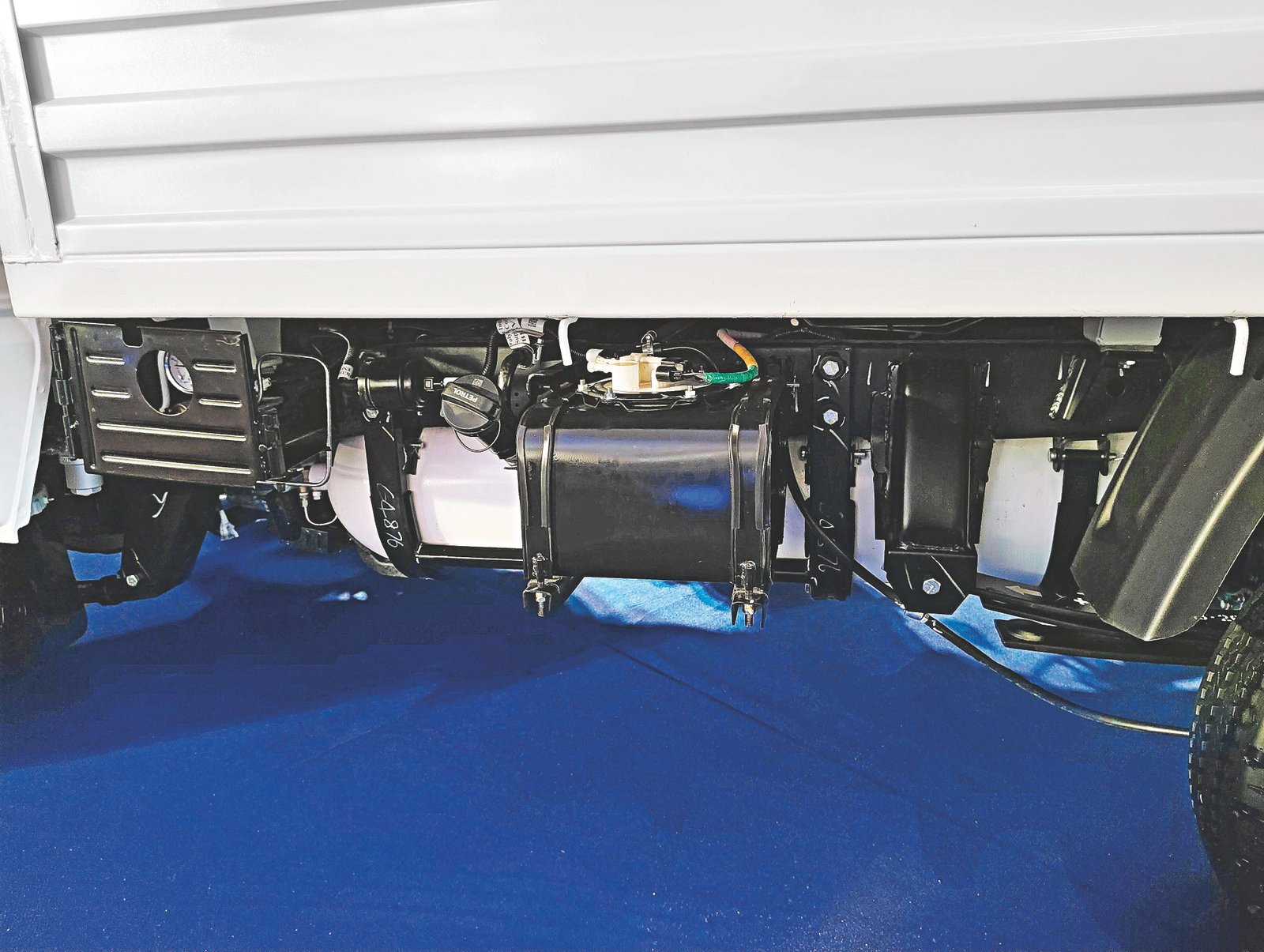
SIAM also said fuel-quality testing under the existing regulatory framework covers more than 150 parameters and is undertaken by OMCs. It noted that the Ministry of Petroleum and Natural Gas has instituted a precautionary three ppm guideline for chloride/sulphur in ethanol entering the petrol supply chain. According to SIAM, OMCs have also instituted water-ingress checks around eight-to-12 times a day at more than 87,000 outlets, as well as checks near petrol pumps following rainfall. SIAM reiterated that the automotive industry remains supportive of E20 as an energy-security initiative and said there was no cause for concern arising from the matter reported.
The withdrawal of the SIAM communication quickly took on political dimensions. Aam Aadmi Party (AAP) national convenor Arvind Kejriwal alleged that the auto industry body was pressured into retracting its findings. Leading an anti-E20 protest march to the Prime Minister’s residence, Kejriwal demanded greater transparency, challenging the government to make its scientific baseline reports public. He criticised the mandatory rollout as a forcible imposition driven by international pressures rather than domestic readiness, arguing that consumers must retain the right to choose conventional petrol.
For consumers, the E20 debate is largely about mileage, performance, vehicle age, maintenance and fuel choice. Lower fuel economy is the most common concern. Since ethanol has lower energy density than petrol, some reduction is expected, but users question the extent of the loss, with the spectrum oscillating widely from up to six per cent on the lower end and going up to 35 per cent on the higher end. Cab aggregators claim the need for fuel pump replacements and costly inspections are eating into their margins at a time of low business. Some owners also report changes in engine response, smoothness or drivability after using E20. Bifuel CVs are being looked at closely for more findings. Some consumers argue that owners of older vehicles should continue to have access to lower-ethanol petrol rather than being required to shift to E20, with pure petrol accessible to the privileged few.

Vikram Pati Singhania, President, ACMA

Rahul Bharti, Senior Executive Officer, Corporate Affairs, Suzuki India Ltd.
The component industry’s position remains closely linked to OEM requirements. Vikram Pati Singhania, President, ACMA, said component manufacturers work closely with vehicle makers, with any changes to components driven by technical requirements identified by OEMs. He emphasised that the industry is still in the early stages of assessing the impact of E20, noting that there is currently insufficient data to determine whether the fuel could cause component damage or the extent of any such impact.
Taking a different but complementary view, Dr Jain, President, GEMA, rejected claims that ethanol-blended petrol damages engines, describing them as technically unsupported. He said the E20 policy followed around four years of research, testing and expert consultation. He said, “Concerns about engine damage from ethanol-blended fuel are largely myths and are not supported by technical evidence.” Jain also pointed to traffic congestion, prolonged idling, driving patterns and vehicle maintenance as factors that can significantly influence fuel efficiency. Meanwhile, the ethanol industry is shifting its focus towards improving production efficiency and reducing costs.
OEMs maintain that extensive testing has already been undertaken on vehicles designed for earlier ethanol blends. Rahul Bharti, Senior Executive Officer, Corporate Affairs, Maruti Suzuki India, said the key concern is not E20 itself, but its use in vehicles manufactured before 2023, when E10 was the prevailing specification. He said, “We have tested E10 cars, which were prevalent before 2023, on E20 fuel for all parameters, and we have not found anything of concern.” Bharti said the testing covered factors including wear and tear, corrosion and component durability, adding that the vehicles had sufficient safety margins to withstand E20 use without compromising the life of the vehicle or fuel-contacting components. He also noted that from 2023, both vehicles and fuel were mandated for E20 compliance, marking the transition from the earlier E10 ecosystem.
A Global Perspective
India is not entering uncharted territory with ethanol, but its model differs from the two major reference markets, Brazil and the US. Brazil has built ethanol into its vehicle ecosystem over decades. Ethanol has been used at scale since the 1970s, while flex-fuel vehicles, introduced in 2003, can run on gasoline, ethanol or varying blends. Brazil also sells both ethanol-blended gasoline and hydrous ethanol, giving consumers a choice based on price and vehicle compatibility. Its mandatory ethanol content in gasoline is now 30 per cent, temporarily raised to 32 per cent in July 2026. The US follows a different model, with E10 widely used, E15 permitted for specified newer vehicles, and E85 reserved for flex-fuel vehicles. The country has more than 17 million FFVs, while E85 is sold through specifically labelled pumps. This creates a clearer link between fuel type and vehicle capability. India, by contrast, has moved rapidly towards a nationwide E20 baseline, while a large legacy fleet remains on the road. Flex-fuel vehicles and E85 are now being introduced, but they remain a developing part of the market.
The Bigger Policy Questions
The E20 debate ultimately raises questions beyond ethanol itself. Should consumers have a choice of fuel blends, particularly when millions of older vehicles remain on the road? Or is a single nationwide blend the more practical approach for a rapidly transitioning market? Vehicle compatibility is another question. While newer models are being developed for E20, should older vehicles receive separate guidance, testing or safeguards based on their age and original fuel specification? Then comes infrastructure. Can storage, transportation and retail systems consistently maintain the required fuel quality across such a vast network? Are existing quality-control and testing mechanisms sufficient as ethanol blending increases? Transparency is equally important. Should fuel-quality testing results, including data on moisture, chloride and other parameters, be published regularly and independently verifiable? Would greater disclosure help distinguish isolated incidents from systemic problems and rebuild consumer confidence?