

In a Frost and Sullivan study on the ASEAN region, the Indonesian bus opportunity comes to the fore, writes Richa Tyagi.
The global bus industry is striving for a common goal. Meeting growing needs of public transportation. Net zero emissions through a multipronged approach of which electrification is an agenda. Frost & Sullivan, in collaboration with the Busworld Foundation, analysed these dynamics in a market perspective report presented at the Busworld Southeast Asia 2026. Thurisina, Associate Director of Mobility at Frost & Sullivan, cited how Indonesia is reforming its public transportation, as part of a broader modernisation strategy. This initiative focuses on the rapid electrification of public bus fleets to address urban pollution and reduce state expenditure on imported fossil fuels against the backdrop of geopolitical conflicts. The shift toward EVs alters vehicle acquisition, asset management, operational planning, and infrastructure development.
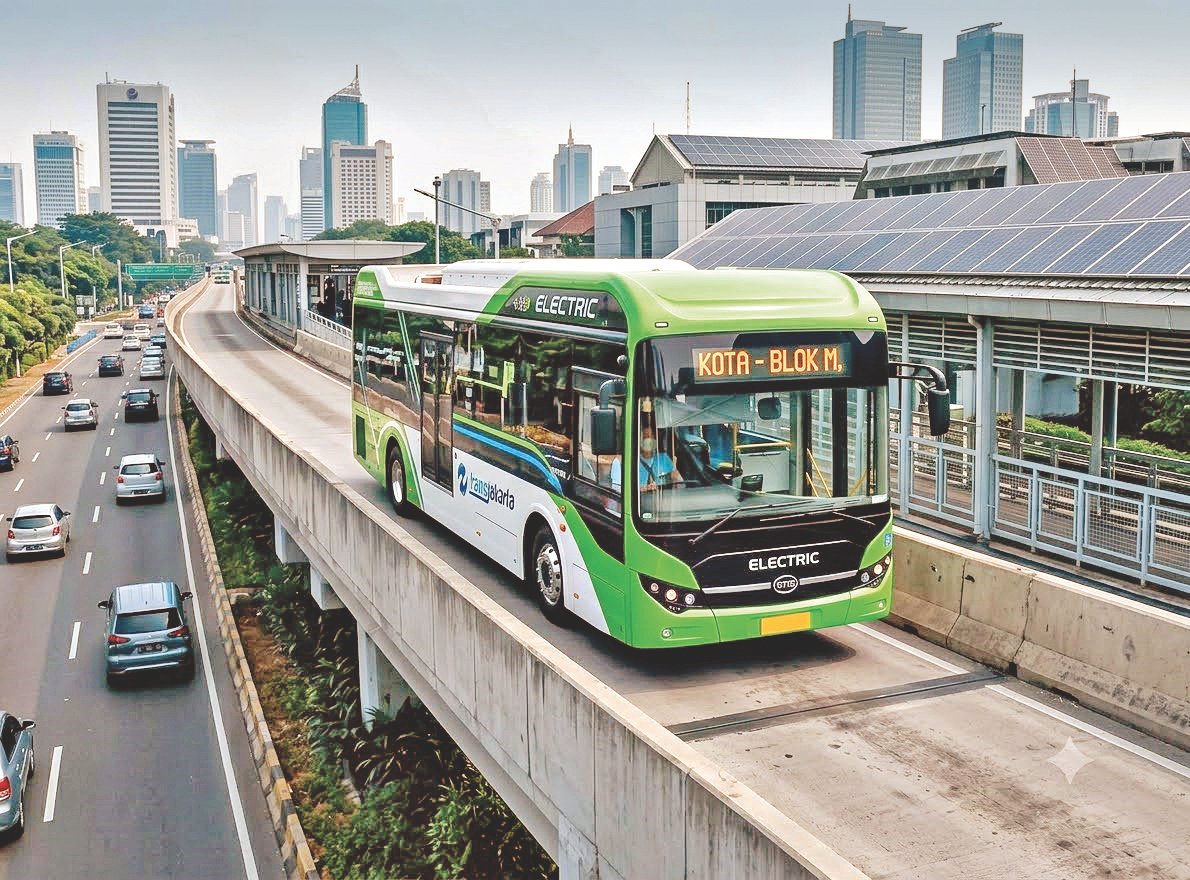
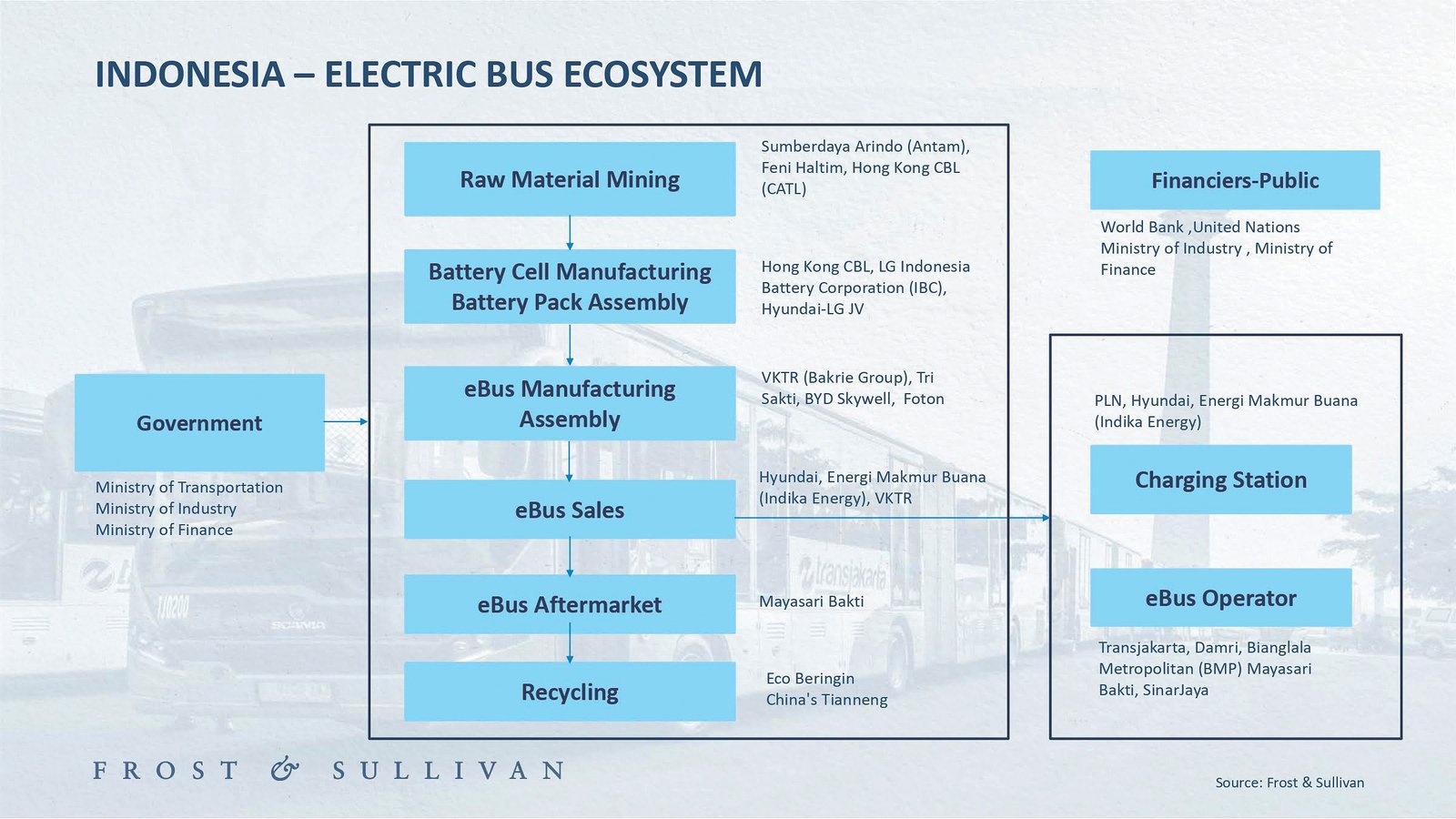
The expansion of the marquee Bus Rapid Transit (BRT) networks across major Indonesian cities underpins this clean energy transition. Operators require dedicated charging and depot infrastructure to support fixed-route transit operations. Consequently, the government coordinates municipal planning with the state electricity utility, PT PLN (Persero), to ensure adequate grid capacity and reliable charging access at terminal points. At the same time, industrial policy targets the creation of a domestic EV production ecosystem, leveraging local mineral wealth to transform Indonesia from a vehicle importer into a regional manufacturing hub.
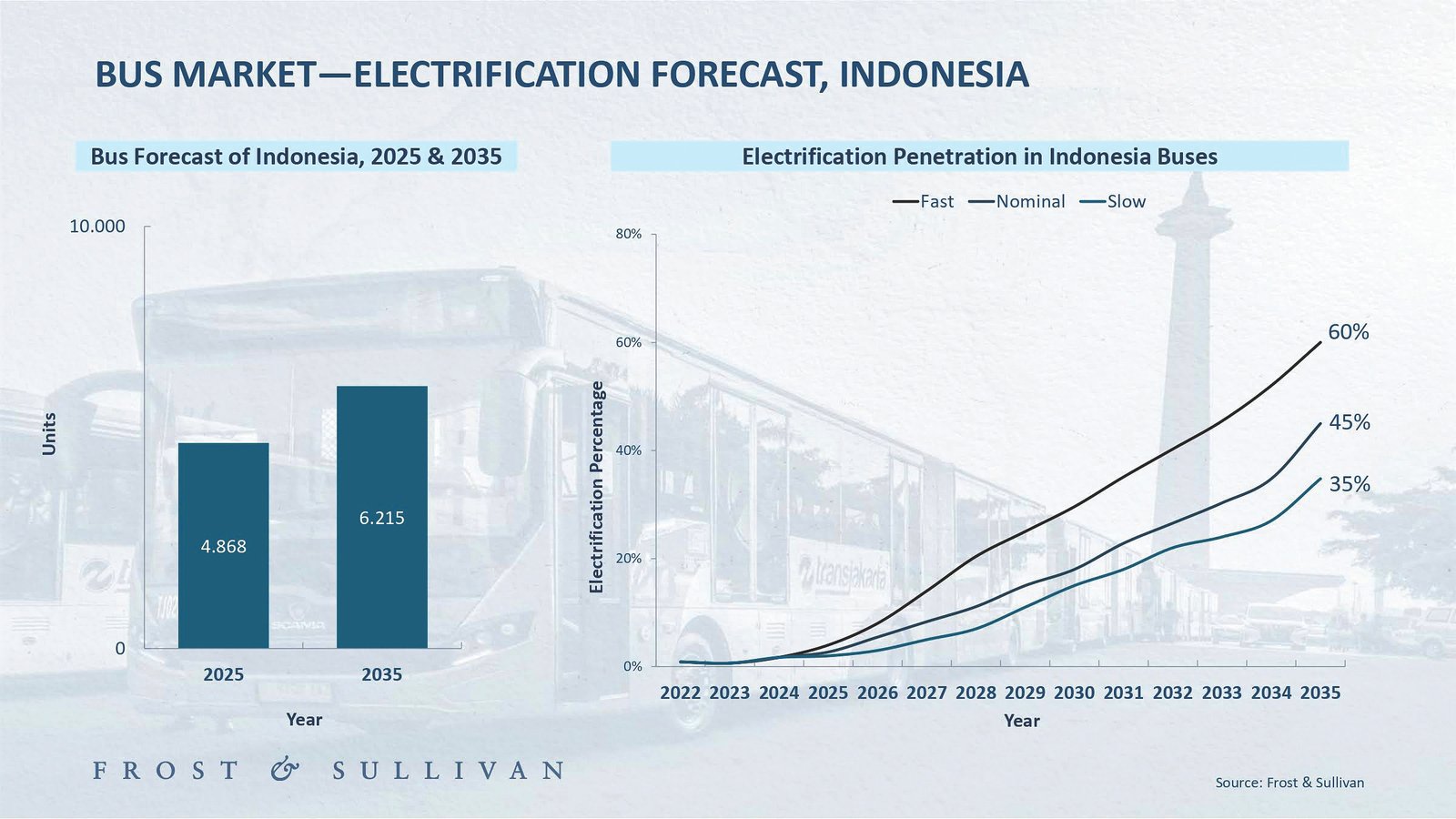
The report projects that the overall Indonesian bus market will expand from 4,868 units in 2025 to 6,215 units by 2035, a jump of 27.7 per cent. Frost & Sullivan models electric bus adoption across three distinct pathways based on regulatory enforcement, infrastructure spending, and macroeconomic factors. Under the Slow Adoption Scenario, limited infrastructure development and fiscal constraints restrict electric bus penetration to 35 per cent of the total market by 2035, at 2,175 units. The Nominal Adoption Scenario projects that steady execution of government mandates and normal fleet replacement cycles will yield a 45 per cent electrification rate by the same year, at 2,797 units. Finally, the Fast Adoption Scenario assumes aggressive subsidy deployment, rapid rollout of private charging depots, and strict emission bans in major cities to drive electric bus penetration to 60 per cent by 2035, at 3,729 units.
Green Vehicle Incentives and Regulatory Framework
The Indonesian government deploys a robust matrix of financial and regulatory incentives to accelerate electric bus adoption and attract foreign direct investment. These policies target multiple stages of the value chain, from raw material processing to fleet operations.
Tax Holidays are expected to play a major role here. The state grants corporate income tax reductions of up to 100 per cent for periods of five to 20 years for strategic investments in EVs, battery manufacturing, and essential components. Extremely large-scale investments can qualify for an additional 50 per cent tax reduction for the subsequent two years.
Tax Allowances will complement the holiday. Investors can access a tax allowance totalling up to 30 per cent of the overall investment value. The state applies this as a five per cent annual reduction in corporate net income tax over six years.
Import Duty Exemptions will facilitate factory setup and early-stage assembly. The government waives import duties on manufacturing machinery for two years, with options for extensions. It also grants two to four years of duty exemptions on production raw materials, provided the manufacturing facility achieves at least 30 per cent local machinery utilisation.
Super Tax Deductions has the government encouraging localisation and technical training by offering gross income reductions of up to 300 per cent for Research and Development (R&D) expenditures and up to 200 per cent for vocational training initiatives.
Bus Production and Supply Chain
The Indonesian bus market relies heavily on global logistics, components, and Complete Knock-Down (CKD) or Semi-Knock-Down (SKD) kits from several primary automotive manufacturing nations. European brands Scania, Sweden and Daimler, operating out of production hubs in Brazil, Spain, and India, supply heavy-duty, premium chassis and high-output powertrains. Tata Motors (of India) delivers cost-competitive commercial chassis options, case-in-point its recent Indonesian orderbook. Chinese manufacturer BYD exports electric vehicle platforms and battery architectures. Japanese manufacturers Fuso, Hino, and Isuzu dominate the conventional diesel light-to-medium bus segments and maintain deep integration with local Indonesian bodybuilders.
Geopolitical Friction and Economic Vulnerabilities
Geopolitical volatility in the Middle East creates direct economic pressures for Indonesian bus operators and bodybuilders (Karoseri). These challenges manifest across commodity prices, energy logistics, and fleet operational costs. Indonesia is a net importer of aluminium and specialised steel sheets. Global commodity price surges force local karoseri to raise their bodybuilding rates, which increases the total purchase price of fully built buses. To mitigate this vulnerability, the state seeks to expand its domestic bauxite mining and aluminium processing using joint investments from state enterprises and Chinese firms. Furthermore, because 20 per cent to 25 per cent of Indonesia’s crude oil and roughly 30 per cent of its Liquefied Petroleum Gas (LPG) imports transit the Strait of Hormuz, maritime disruptions drive up shipping freight rates, raising the landed cost of imported CKD kits.
The conflict impacts the pricing and supply of moulded fibreglass, resins, and polyurethanes used in bus body panels and interior components. Indonesia imports naphtha to manufacture polymers. When global naphtha prices spike, the cost of raw fibreglass and resins increases, reducing the profit margins of local bodybuilders.
As per the report, Indonesia mandates Euro 4 and Euro 6 emission standards for new commercial vehicles. These advanced engines cannot run on subsidised, lower-grade diesel (Biosolar) without risking component damage. Operators must purchase non-subsidised diesel (Pertamina Dex), which raises the Total Cost of Ownership (TCO). To counter high import costs for refined diesel from Singapore and Middle Eastern hubs, the government enforces domestic palm oil blending. The state implemented a B40 (40 per cent biodiesel blend) mandate in 2025, and plans to introduce a B50 (50 per cent biodiesel blend) mandate to substitute fossil fuel imports.
These cumulative fuel cost shocks incentivise the transition to electric transit. The Indonesian government accelerates public transport electrification to insulate the economy from volatile diesel prices. For example, Transjakarta aims to achieve a 50 per cent electric bus fleet by 2028 and targets a total fleet size of 10,000 buses by 2030. Other secondary municipalities are developing similar fleet electrification programs by leveraging national green vehicle incentives.
ADAS Market Maturity
The integration of Advanced Driver Assistance Systems (ADAS) in Indonesia remains in an early stage, characterised by low market penetration and high price sensitivity. Several market realities restrict ADAS adoption in the short term, as high upfront technology costs create a major barrier for price-sensitive regional operators, and most entry-level and mid-tier chassis platforms sold in Indonesia lack the factory-installed sensors, radar modules, and electronic control units required for advanced driver assistance. Furthermore, low consumer awareness, a lack of local calibration and after-sales maintenance networks, and limited regulatory mandates or New Car Assessment Program (NCAP) safety incentives for commercial vehicles slow market adoption. While European OEMs like Daimler began introducing essential safety features like Blind Spot Warning and Advanced Emergency Braking (AEB) on premium chassis lines, short-term adoption relies on low-cost, ADAS-ready platforms entering the market from Chinese manufacturers. Consequently, Frost & Sullivan recommends that bodybuilders bundle cost-efficient AEB and blind spot warning packages for high-volume bus models, a strategy that helps operators secure lower insurance premiums and supports regulatory efforts to improve public safety.
Bus Telematics Market Matrix
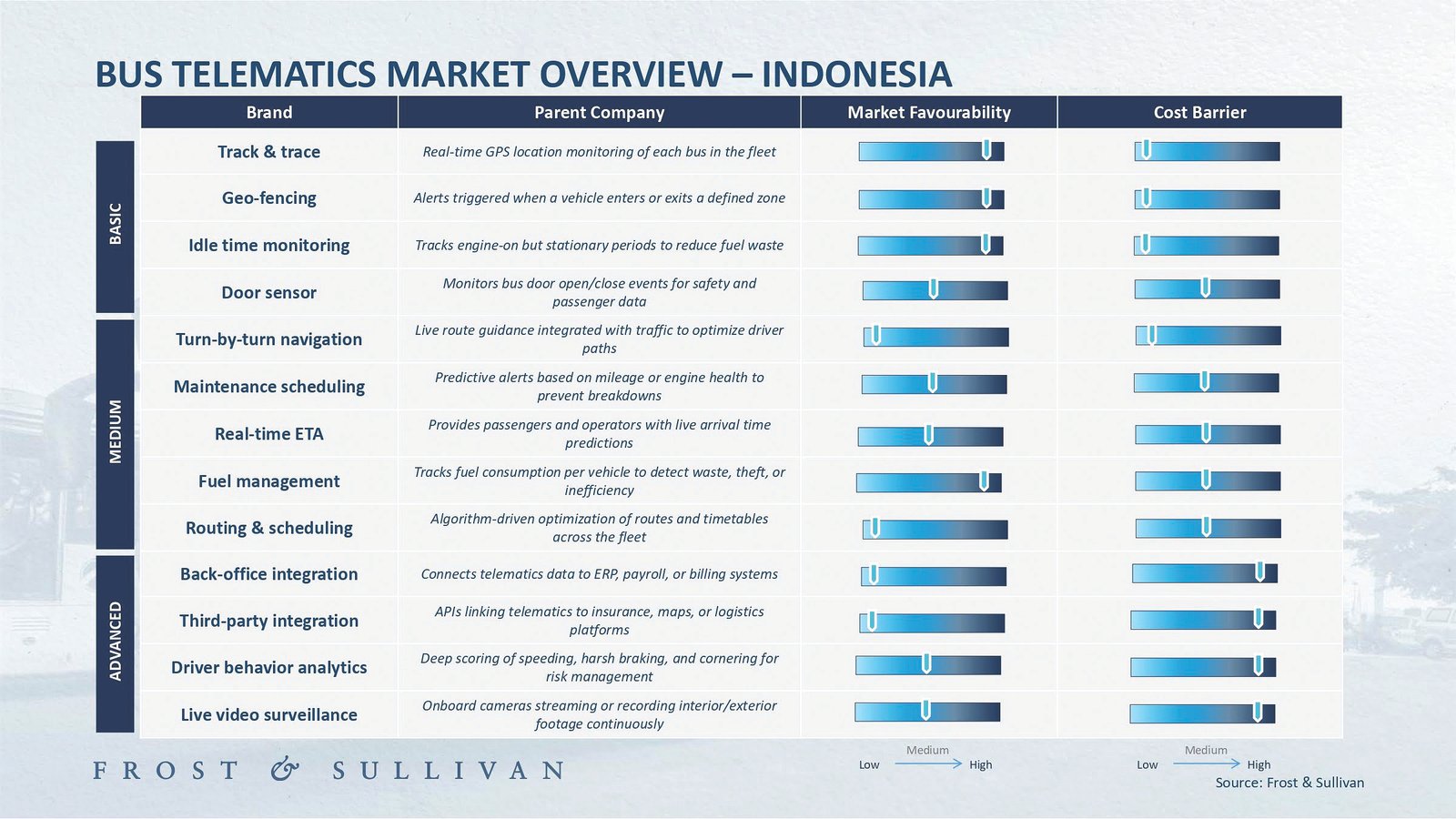
In contrast to advanced ADAS hardware, the Indonesian bus telematics market shows a higher commercial adoption rate. Operators deploy fleet management software to optimise operational costs and monitor vehicle health. Telematics systems scale across three clear tiers of functionality. Basic systems offer low-cost features like real-time GPS tracking, geo-fencing alerts, idle-time monitoring to prevent fuel waste, and digital door sensors for passenger safety. Medium-tier systems balance costs with operational savings by introducing turn-by-turn live navigation, predictive maintenance scheduling based on engine health, real-time passenger ETA feeds, and fuel consumption tracking to eliminate theft or inefficiency. Advanced platforms require higher investments to deliver algorithmic fleet routing, back-office ERP database synchronisation, and third-party API connectivity for logistics or insurance platforms. They also process driver behaviour analytics to generate safety risk profiles and stream live, multi-angle onboard video surveillance to central stations for liability management.