


Emerging maritime technologies converged in Mumbai as ports, policy makers and startups showcased solutions for a new India at Maritime Week 2025, writes Upendra Kasbekar.
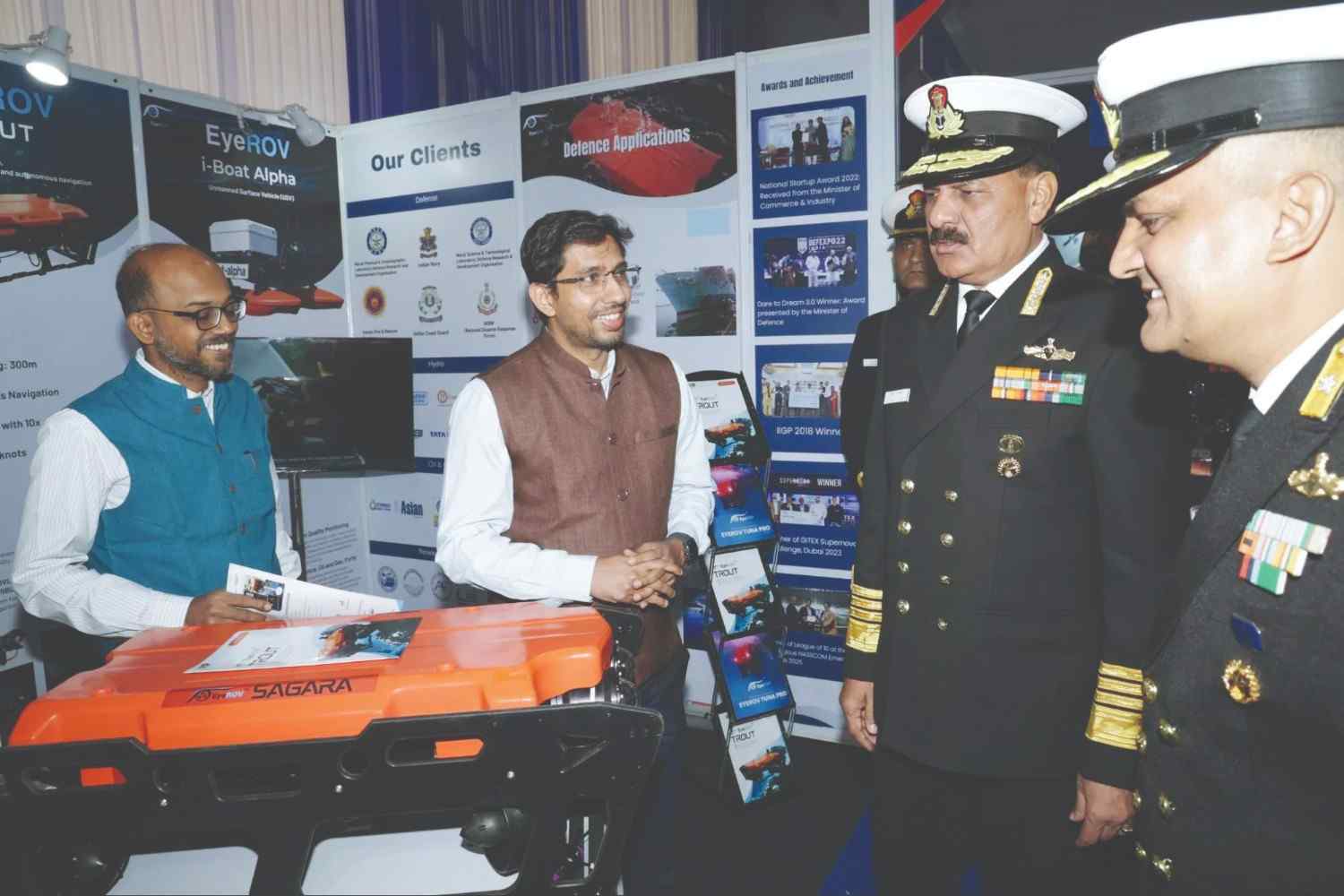
India Maritime Week 2025, held in Mumbai, underscored the growing strategic weight of the maritime sector in India’s economic and security landscape. The event brought together policy makers, port authorities, public-sector undertakings, private terminal operators, shipbuilders, logistics players, technology providers and startups, reinforcing the government’s intent to modernise the maritime ecosystem through technology-led interventions.
Beyond its scale, the exhibition reflected a clear shift in priorities. Digitisation of port operations, asset life-cycle management, safety and surveillance, automation and sustainability dominated discussions and exhibits. Public-sector ports outlined capacity expansion and modernisation roadmaps aligned with India’s port-led development agenda, while private operators highlighted efficiency-driven infrastructure models and integrated logistics platforms. The presence of defence and maritime security agencies further reinforced the sector’s strategic dimension.
What emerged clearly was that India’s maritime growth narrative is no longer defined only by ships, berths and terminals. Increasingly, it is shaped by electronics, robotics, sensors, software platforms and intelligent systems that operate above and below the waterline, enabling safer, more efficient and more predictable maritime operations.
Why Startups Matter
A notable shift at Maritime Week 2025 was the growing prominence of startups within a sector traditionally dominated by large public-sector entities and global system integrators. Startups are no longer peripheral participants; they are increasingly viewed as enablers of specialised technologies that address clearly defined operational gaps. In the maritime domain, areas such as underwater inspection, asset monitoring, surveillance and disaster response demand focused engineering solutions rather than broad, one-size-fits-all platforms.
Government initiatives such as Make in India, Atmanirbhar Bharat and defence innovation frameworks have accelerated this transition. These programmes have encouraged public agencies to evaluate indigenous technologies while lowering entry barriers for startups working in complex domains such as marine robotics, autonomous systems and advanced sensing. As a result, a new generation of Indian startups is now contributing directly to maritime capability building, rather than remaining confined to pilot projects or demonstration deployments.
It is within this evolving startup-led innovation environment that companies like EyeROV have found relevance. As maritime authorities and defence agencies increasingly seek solutions that are deployable, reliable and suited to Indian operating conditions, specialised startups are filling gaps that large OEMs and integrators often struggle to address with the same agility or application depth.
Technologies Drawing Attention
The exhibition halls at Maritime Week 2025 showcased the convergence of conventional maritime infrastructure with next-generation technology. Port authorities demonstrated digital command centres, vessel traffic management systems and predictive maintenance platforms aimed at improving asset utilisation and reducing downtime. Automation in cargo handling and smart yard management reflected the push towards higher throughput and operational efficiency.
Safety and surveillance technologies formed another strong theme. Coastal monitoring systems, advanced radar solutions and underwater inspection tools highlighted an increasing focus on risk mitigation and real-time visibility across maritime assets. Sustainability-oriented solutions, including energy-efficient port equipment and greener infrastructure designs, reinforced the sector’s alignment with environmental objectives.
Within this broader technology narrative, underwater inspection and monitoring emerged as a recurring focus area. As ports expand, offshore assets multiply and maritime security concerns intensify, the limitations of diver-based inspection methods are becoming more evident. This shift created a natural opportunity for remotely operated and robotic systems to gain attention from both government and industry stakeholders.
EyeROV at the Centre
Among the startups that drew consistent interest at India Maritime Week 2025 was Kochi-based EyeROV, a marine robotics company specialising in underwater remotely operated vehicles (ROVs). EyeROV’s engagement with visitors stood out for its operational focus, with discussions centred on deployment depth, inspection accuracy, reliability and turnaround time rather than conceptual demonstrations.
Founded in Kochi, EyeROV has built credibility through repeated real-world deployments across ports, dams, offshore assets and defence installations. Emphasising the importance of field validation, Kannappa Palaniappan P, Co-founder and Chief Technology Officer, EyeROV, said, “For eight years, EyeROV has engineered underwater systems tested in the harshest conditions. This partnership with the Navy is proof that Indian innovation can set benchmarks globally in defence deep-tech.”
The statement captured why EyeROV’s presence resonated at the event not merely as a startup showcase, but as an example of indigenous technology transitioning into mission-critical maritime and naval applications.
Products and Use Cases
EyeROV’s underwater remotely operated vehicles are built around a tethered, industrial-grade architecture designed for extended inspection and intervention tasks in turbid and high-current marine environments. The tethered configuration allows continuous power supply from the surface and real-time transmission of video and sensor data, eliminating endurance constraints associated with battery-only underwater systems. This design choice is particularly relevant for long inspection cycles required in ports, dams and offshore installations.
Structurally, the ROVs feature sealed pressure housings and corrosion-resistant frames engineered for sustained underwater operation. Multiple electric thrusters are positioned to provide controlled movement and stable station-keeping, enabling precise manoeuvring along vertical and confined structures such as quay walls, bridge piers and dam faces. The control philosophy prioritises stability and precision over speed, reflecting the inspection-centric nature of the applications.
The primary inspection interface consists of high-definition cameras supported by dedicated underwater lighting systems. In low-visibility conditions, sonar-based imaging supplements optical data, allowing operators to map submerged structures and identify anomalies that would otherwise be difficult to detect. All inspection data is relayed to a surface control unit, which functions as the operational hub for real-time monitoring, recording and analysis.
Within EyeROV’s portfolio, the TUNA platform is positioned as an observation-class ROV intended for routine inspection tasks. Its compact form factor and rapid deployment capability make it suitable for harbour basin surveys, dam wall inspections, underwater asset verification and emergency response assessments. For more demanding environments, EyeROV offers heavier-duty platforms such as TROUT, engineered for deeper operations and more complex underwater conditions. These systems support modular payload integration, enabling additional sensors or tools to be configured based on mission requirements.
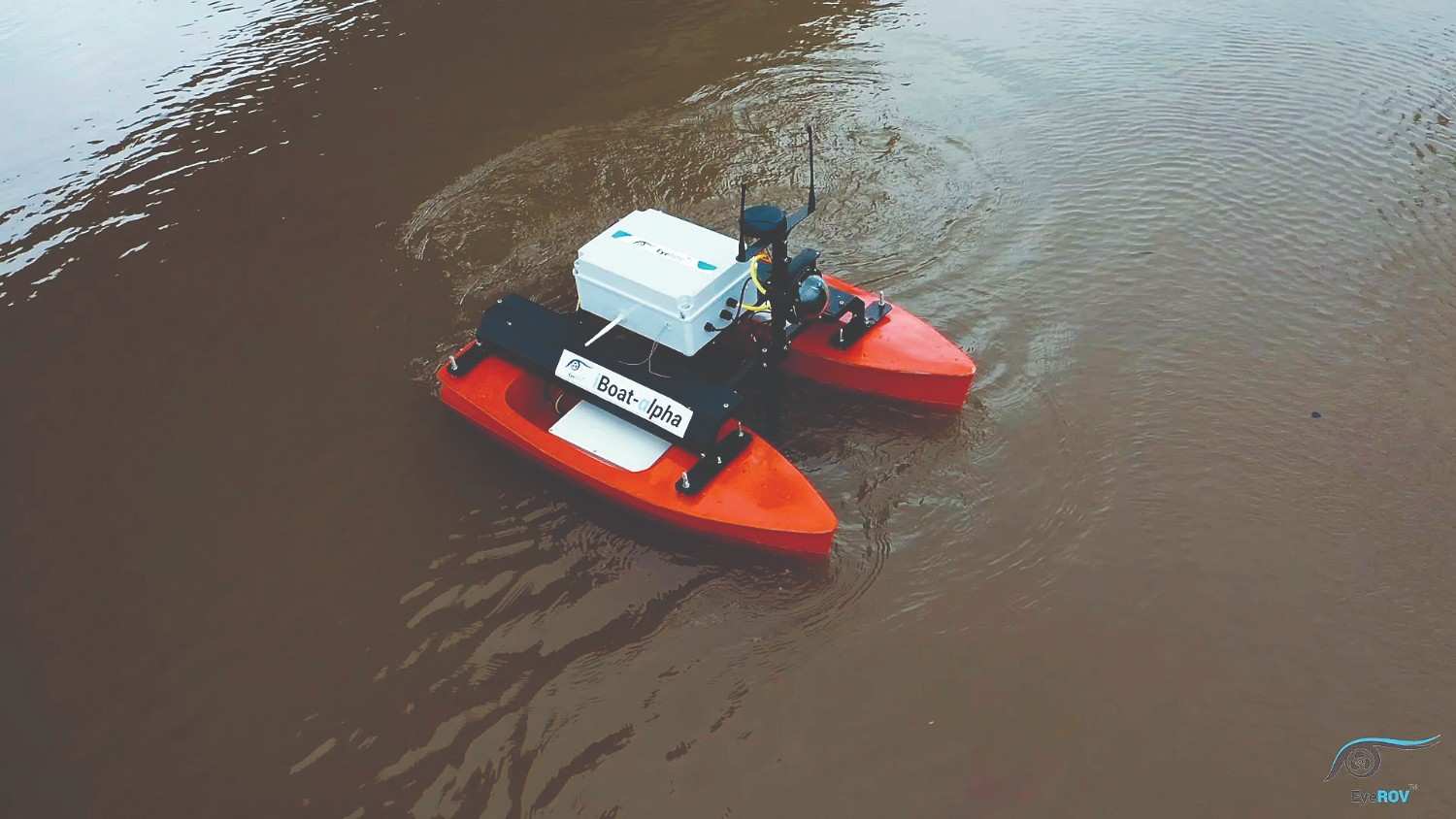
Complementing its subsea vehicles, EyeROV has also developed unmanned surface platforms that can support underwater missions by acting as deployment points or communication relays. This combined surface–subsea approach enhances operational flexibility, particularly in large reservoirs, ports and offshore locations. Explaining the application-driven philosophy behind its systems, the company has stated that “our indigenous ROV systems are engineered for underwater search and recovery, disaster response and AI-powered inspection, enabling operators to function safely in hazardous underwater zones.” Publicly available information indicates that EyeROV has completed over 100 underwater deployments across India and overseas, spanning port infrastructure, inland water assets, offshore facilities and defence-related applications. While unit sales figures are not publicly disclosed, the scale and repeat nature of deployments suggest operational adoption rather than pilot usage.
Government Engagement and Validation
EyeROV’s growing profile is reinforced by its engagement with government and defence institutions. A significant milestone was the Rs.47-crore contract awarded by the Indian Navy for the supply of advanced underwater remotely operated vehicles. Such defence engagements typically involve stringent qualification and testing standards, underscoring the maturity of the technology.
Beyond the Navy, EyeROV has worked with government agencies, research institutions and public-sector undertakings involved in maritime infrastructure, environmental monitoring and disaster response. Articulating the company’s long-term intent, Johns T Mathai, Co-founder and Chief Executive Officer, EyeROV, stated, “Our vision has always been to serve the nation by delivering technologies that are at par with global standards.”
International Footprint
EyeROV’s relevance is not limited to the domestic market. The company has established an overseas presence, including a regional base in Doha, Qatar, through a local partner, indicating active engagement with international customers. In addition, EyeROV’s systems have been deployed across West Asia, the Asia-Pacific region and parts of Europe, demonstrating adaptability to varied marine environments and regulatory contexts. This international exposure strengthens EyeROV’s positioning as an Indian startup with global applicability, particularly as demand rises worldwide for unmanned underwater inspection and monitoring solutions.
Looking Ahead
As India’s maritime infrastructure expands and operational complexity increases, demand for advanced inspection and monitoring technologies is set to rise. Underwater robotics, supported by advances in sensors, control electronics and data analytics, will play a growing role in improving safety, reducing downtime and enhancing asset management. For EyeROV, continued product refinement, deeper integration of autonomy and expansion into new maritime use cases will be critical to sustaining momentum.
India Maritime Week 2025 highlighted a maritime sector in transition one where technology, policy and entrepreneurship are converging to shape the future of ports, shipping and maritime security. Startups like EyeROV exemplify this shift, demonstrating that indigenous companies can deliver robust, mission-critical solutions for complex underwater environments. As India advances towards its ambition of becoming a global maritime hub, such technology-driven startups will play a crucial role in ensuring that growth is resilient, safe and sustainable.