

The innovations in the L3 and L5 segment hint at a continued momentum in the three-wheeler segment. Bajaj Riki taps into it with its low-cost, reliable, safe and engineered platform to mark the shift, writes Upendra Kasbekar.
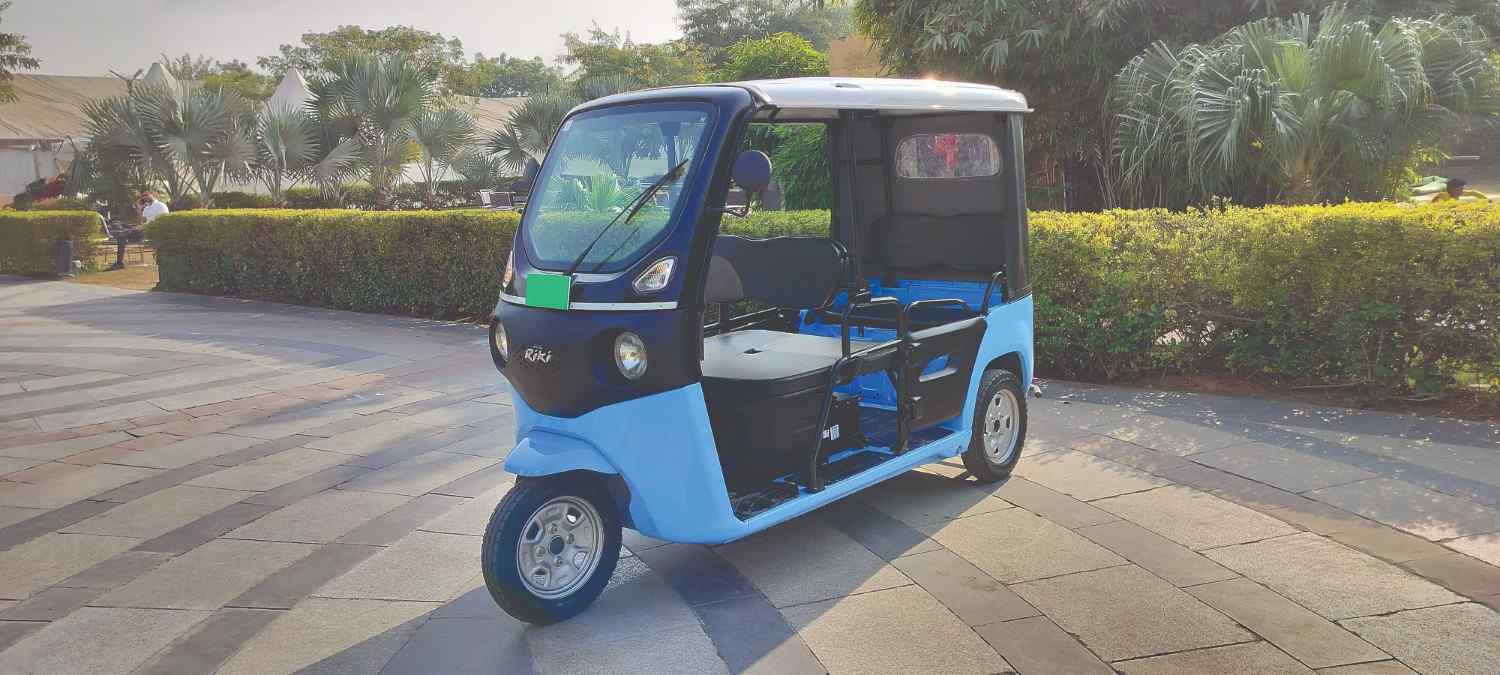
The first few minutes inside the Bajaj Riki P4005 are enough to realise the departure from the familiar sensations that drivers have come to expect from lesser, unregularised e-rickshaws. The cabin feels sturdier, quieter, and refined. There is no vibration from a struggling powertrain, no metallic rattle from a loosely assembled frame, no anxiety about whether the vehicle will roll back on an incline. As the vehicle eases forward inside the controlled environment of Bajaj Auto’s test zone, the muted whirr of its electric motor replaces the harsh buzz typical of lead-acid machines. The initial pull is calm and measured, offering none of the abrupt low-speed jerkiness that the segment has normalised all these years.
It points at a well-calibrated powertrain and stable chassis addressing the lack of engineering discipline, safety assurances and predictable operating economics. Samardeep Subandh, President of Bajaj Auto’s Intra-City Business Unit, articulates the intent succinctly. “Riki brings Bajaj Auto’s trusted 3W engineering and dependability into the electric rickshaw segment at a time when drivers and passengers need dependable solutions,” he says. “We’ve brought the best for the industry longest range, monocoque chassis, independent suspension and hydraulic brakes. Riki is engineered to increase driver earnings, enhance passenger safety and comfort, and deliver the reliability India’s last-mile ecosystem has waited for.” The comment reflects Bajaj’s broader ambition to formalise a category where safety, uptime and Total Cost of Ownership (TCO) have historically been inconsistent.
The Riki also marks Bajaj’s re-entry into the last-mile L3 passenger and cargo category through the Riki P4005 and C4005. It comes as the industry undergoes an unprecedented scale-up. India now adds nearly 40,000 e-rickshaws every month, accounting for roughly 38 per cent of the L3 segment, with e-autos at 19 per cent and ICE three-wheelers holding the remaining share. This surge, however, masks a systemic challenge. A majority of these vehicles come from unorganised manufacturers who allegedly prioritise low upfront cost over structural integrity, proper suspension geometry, safe braking systems and long-term reliability.
Drivers have lived with persistent range anxiety, slow eight–to-10 hour charging cycles, frequent breakdowns, toppling concerns due to poor weight distribution, cramped seating layouts and minimal weather protection. In this landscape of compromises, Bajaj Riki is positioned as not just an incremental improvement, but as a fundamental redefinition of expectations.
According to Rakesh Sharma, Executive Director at Bajaj Auto, Riki reinforces the long-term strategy. Having piloted Riki in Patna, Moradabad, Guwahati and Raipur, the company is now expanding to eight cities, with a planned push to nearly 200 towns in the next quarter. “We are just seeding the market now,” Sharma clarified. “In January to March, we will scale up, and once we witness traction, we will move into meaningful volumes.” The confidence comes from a belief that the segment is ready for transformation if manufacturers can offer products that endure the stresses of high-utilisation, daily-cycle operation in demanding conditions.
At the heart of the Riki P4005 lies a 5.4 kWh LFP battery pack engineered for a claimed 149 km range and a full recharge in under four hours. The LFP chemistry is said to offer thermal stability and non-flammability, while the IP67 rating ensures resilience during monsoons and waterlogged operations. The C4005 cargo variant pushes range to 164 kilometres, catering to micro-logistics operators who require dependable multi-trip cycles. The battery integrates cleanly with the welded steel chassis as a reinforcing member, a layout far more rigid than the frame-built structures seen across unorganised e-rickshaws.
Riki’s operating cost averages around one rupee per kilometre, delivering nearly Rs.2.5 per kilometre in savings compared to a typical CNG rickshaw.
Suspension and braking are two areas where Riki sets itself apart. Independent suspension paired with an anti-roll bar delivers a level of composure uncommon in the segment, especially on uneven roads. The system mitigates lateral roll during cornering and keeps the vehicle settled during sudden lane changes, a valuable trait in dense urban corridors where instances of falling over are not uncommon. Hydraulic brakes, a rarity in this category, offer more progressive stopping power and significantly reduce brake fade over sustained use. The result is shorter and more predictable stopping distances, improving safety for both drivers and passengers.
The platform’s 19 per cent gradeability in the P4005 and 28 per cent in the C4005 reflect Bajaj’s intent to make the Riki suitable for cities with steep flyovers and uneven topography. This is complemented by a turning radius of 2.88m, which keeps the vehicle agile in tight markets and narrow lanes. Even the exterior design reflects deliberate intent. A blend of matte black, glossy black and bright body colours strengthens the vehicle’s road presence and visibility. The angular front fascia, integrated wiper assembly, dual headlamps and easily removable fibre panels make servicing simpler for technicians, ensuring minimal downtime.
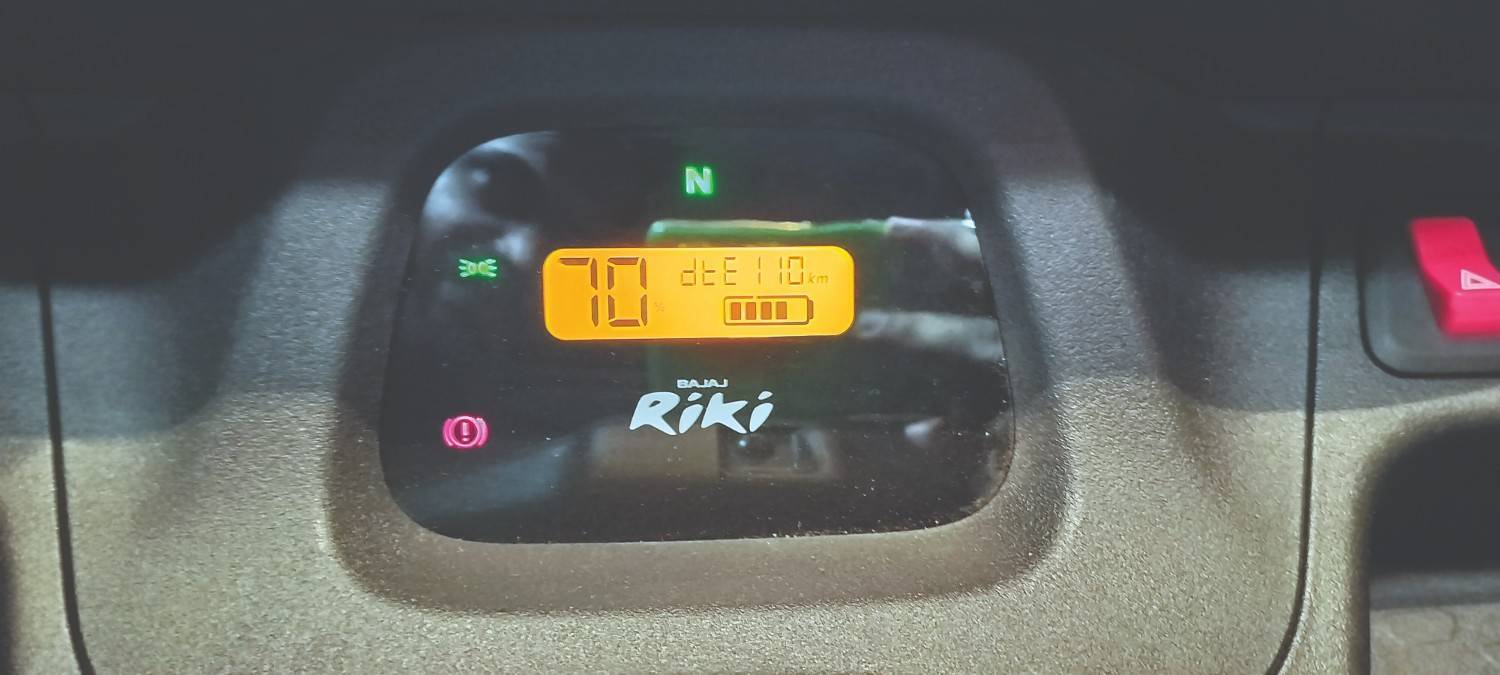
The drive helped relate better with the pilot workspace. The wide vertical windscreen creates a free forward view, while the tall roof and extended footwell ensure a natural seating posture even for taller drivers. The hard-fibre dashboard houses a digital cluster displaying battery SoC, distance-to-limp, speed and drive modes. Convenient storage pockets, a 12V port, USB slot and a factory-fitted mobile holder create a driver-centric environment. Mirrors cover almost an entire lane, eliminating the blind spots that often complicate merges and turns.
Passenger space is one of Riki’s quiet triumphs. The cabin can accommodate four adults seated face-to-face without knees rubbing, a marked improvement over cramped unorganised-market layouts. The fibre-coated steel doors feel reassuringly solid, while the optional monsoon curtains make the cabin usable throughout the year. A roof-mounted carrier offers additional practicality without upsetting weight distribution. These design choices underscore Bajaj’s aim to combine safety and comfort with predictable performance.
On-Road Impressions
A short driving session in the Riki P4005 helped relate to the OEM claims in a real-world simulation. . The rollout is seamless on engaging the throttle. The map is progressive and avoids sudden spikes typical of low-cost controllers. Acceleration is controlled rather than abrupt, which suits the stop-start nature of intracity routes. Steering is slightly firm at crawling speeds but remains manouverable in the 10–15 kmph speed range, aided by the rigid chassis and balanced weight distribution. Braking is particularly impressive. The vehicle stops almost instantly at low speeds, and at 10–15 kmph, the stopping distance remains around a metre. This translates to safer navigation in crowded areas where jaywalkers, cyclists and two-wheelers constantly come onto the vehicle’s path.
The gradient test further reinforced the platform’s stability. The Riki P4005 climbed steadily at low speeds and with greater assurance when given a brief run-up. Hill-hold assist prevented rollback, allowing the driver to take off cleanly even on steeper inclines. While the unladen suspension presents a bounce, the laden state is expected to stabilise the ride.. NVH levels are impressively low, with the electric motor generating only a subdued hum. The absence of petrol or CNG engine noise heightens the sense of refinement.
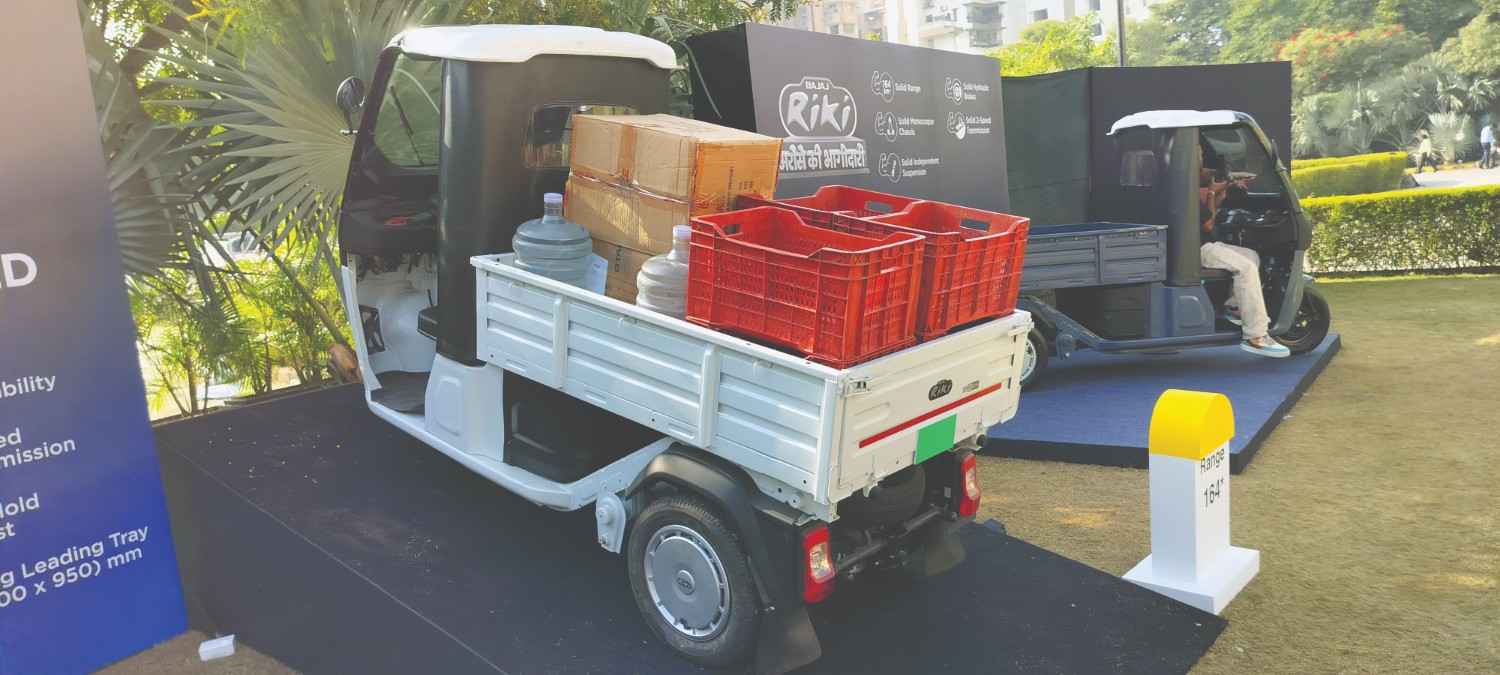
The C4005 cargo variant extends Riki’s capability into the micro-logistics space. Though compact in overall dimensions, its 3.2-by-4 ft. tub can carry around 0.3-tonne (300 kgs) as the rated payload. This is aided by themonocoque architecture. This makes it well-suited for vegetable and grocery suppliers, milk and water distributors, tyre retailers, parcel operators and small construction material handlers. The C4005 draws in the P4005 USPs for driver ergonomics and comfort at large.
Market positioning
Market suitability varies across regions. Riki’s strong engineering makes it particularly compatible with Tier-2 and Tier-3 cities such as Lucknow, Amritsar, Gaya and Jamshedpur, where e-rickshaws form the backbone of daily commute chains linking metro stands, markets and suburban clusters. Mumbai, however, presents a different challenge. Its hyper-dense traffic patterns, extreme humidity, salt-laden air and narrow inner lanes reduce operational advantage, while established feeder auto networks and limited overnight charging infrastructure complicate adoption. By contrast, semi-urban regions offer clearer pathways for Riki’s strengths range, safety, durability and low maintenance to translate into improved earnings and predictable utilisation.
Bajaj views Riki as the product that will shift the balance of the e-rickshaw market away from unorganised players. The company’s long-standing dominance in three-wheel mobility gives it a natural trust advantage.Its pricing at (Ex-showroom) Rs. 1.90 lakh, competes aggressively with the lesser brands.
Bajaj Auto has confirmed that Riki will expand from its pilot phase to nearly 200 cities by early 2026. The company is ramping up domestic production capacity and strengthening EV assembly processes, but has not yet announced any export plans for the Riki platform.