

In an industry where navigation has long been defined by speed and distance, drivebuddyAI is shifting the conversation toward something far more consequential the quality of the road itself. The company has secured a patent for its Integrated Dynamic Road Quality Assessment System and Method, a technology that introduces a new layer of intelligence to mobility by making road conditions a measurable, actionable parameter.
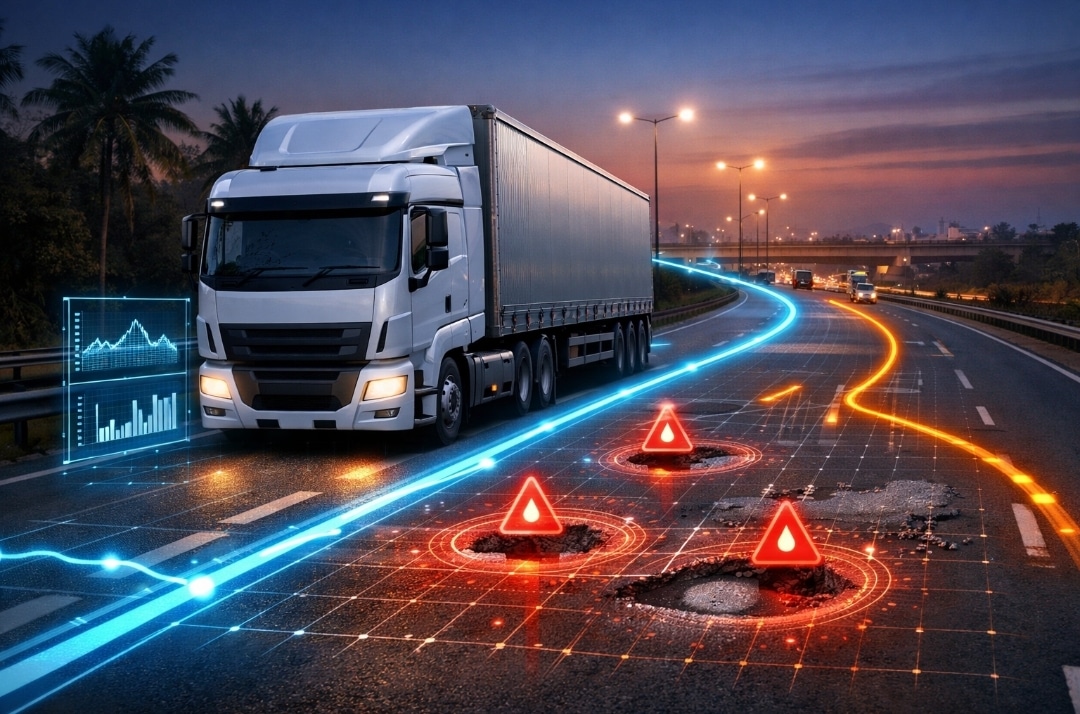
At its core, the system addresses a blind spot that has persisted across mapping and navigation platforms: while algorithms optimise for the shortest or fastest route, they remain indifferent to the physical reality of the road surface. For fleets operating under tight turnaround times (TAT), this omission is far from trivial it is operationally expensive.
drivebuddyAI’s approach blends sensor fusion with AI-led visual validation. A GNSS module continuously logs vehicle speed and geo-coordinates, while an IMU sensor captures multi-axis acceleration. The moment a vehicle encounters a pothole or uneven surface, a spike in vertical (Z-axis) acceleration flags a potential anomaly. But the system doesn’t stop at detection. Each flagged event is cross-verified through video data, processed by a fine-tuned deep learning model trained on Indian road conditions, ensuring that only genuine defects make it to the dataset.
The result is not a static map, but a constantly evolving intelligence layer. As vehicles traverse routes, the system keeps updating geo-tagged road quality data in real time, effectively transforming fleets into moving sensors that build a living, breathing map of road conditions.
This has direct implications for fleet economics. Poor road surfaces do more than slow vehicles they accelerate wear and tear, increase fuel inefficiencies, trigger frequent braking, and elevate the risk of cargo damage. For industries moving sensitive or high-value goods, even marginal road degradation can cascade into missed SLAs, higher maintenance cycles, and financial losses.
As Nisarg Pandya, Founder & CEO of drivebuddyAI, succinctly puts it, “The industry has focused on where you are going, not what the road will do along the way. Road quality sits at the intersection of safety, efficiency, and cargo integrity and ignoring it comes at a cost.”
By integrating road quality intelligence into route planning, drivebuddyAI is effectively reframing what “fastest route” truly means. A route that appears optimal on a map may, in reality, prove inefficient when factoring in delays caused by poor infrastructure. With this system, fleet managers can make decisions grounded in real-world conditions, not just algorithmic assumptions.
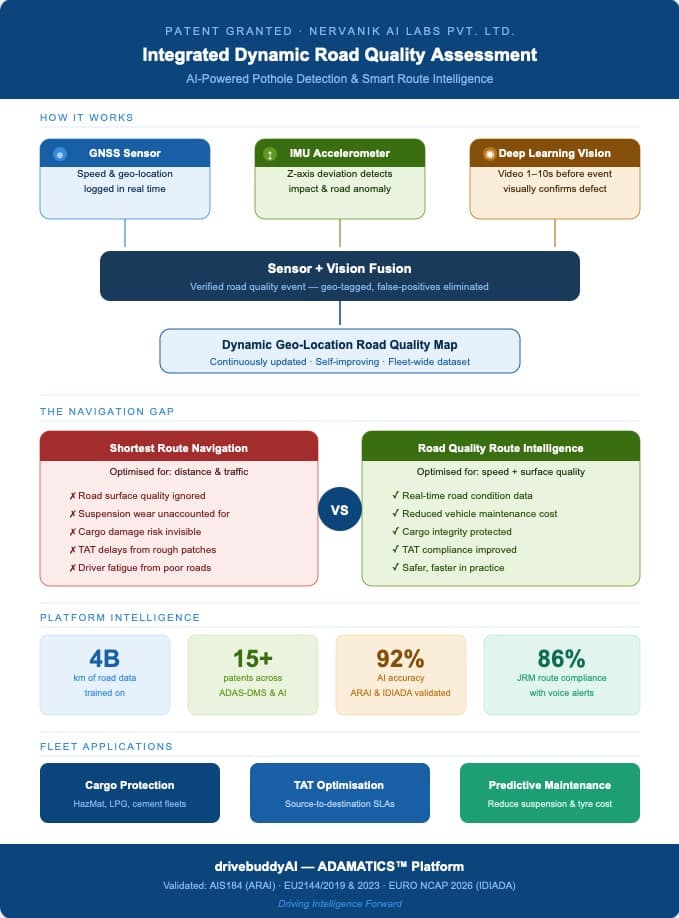
The patent further strengthens drivebuddyAI’s growing portfolio of over 15 innovations across ADAS, DMS, and AI perception systems. From driver recognition and mapping to drowsiness detection and cognitive risk assessment, the company’s work reflects a consistent focus: building technology that responds to real-world challenges, particularly those unique to Indian roads.
More significantly, the validation of these systems against global benchmarks such as AIS184, EU2144/2019 & 2023, and EURO NCAP 2026 standards signals a maturing ecosystem where India-centric innovation is beginning to align with international safety frameworks.
In a mobility landscape increasingly defined by data, drivebuddyAI’s latest patent does more than introduce a feature it redefines the metric. Because in the real world, the fastest route is not just the shortest one, but the one that gets you there intact, on time, and without compromise.