

The e-LCV Montra EVIATOR challenges the status quo in new-age last-mile city logistics with a ground-up electric platform built for urban efficiency, writes Richa Tyagi, as she evaluates the EVIATOR’s drivability, usability, and real-world city performance, while the second part traces the vehicle’s journey from sub-assemblies to a fully built electric LCV, examining its manufacturing processes, platform make-up, and engineering choices, writes Sahil Kesari.
A new wave of products engineered for India’s demanding logistics ecosystem are cropping up. Among the latest entrants is the challenger e-LCV, Montra Electric Eviator. The 3.49-tonne (3,490 Kg) GVW SCV-pickup truck is positioned to meet the demands of last-mile city logistics in intra-city transport.. The Eviator is a born-electric platform, claimed to have been engineered by Montra from the ground up.
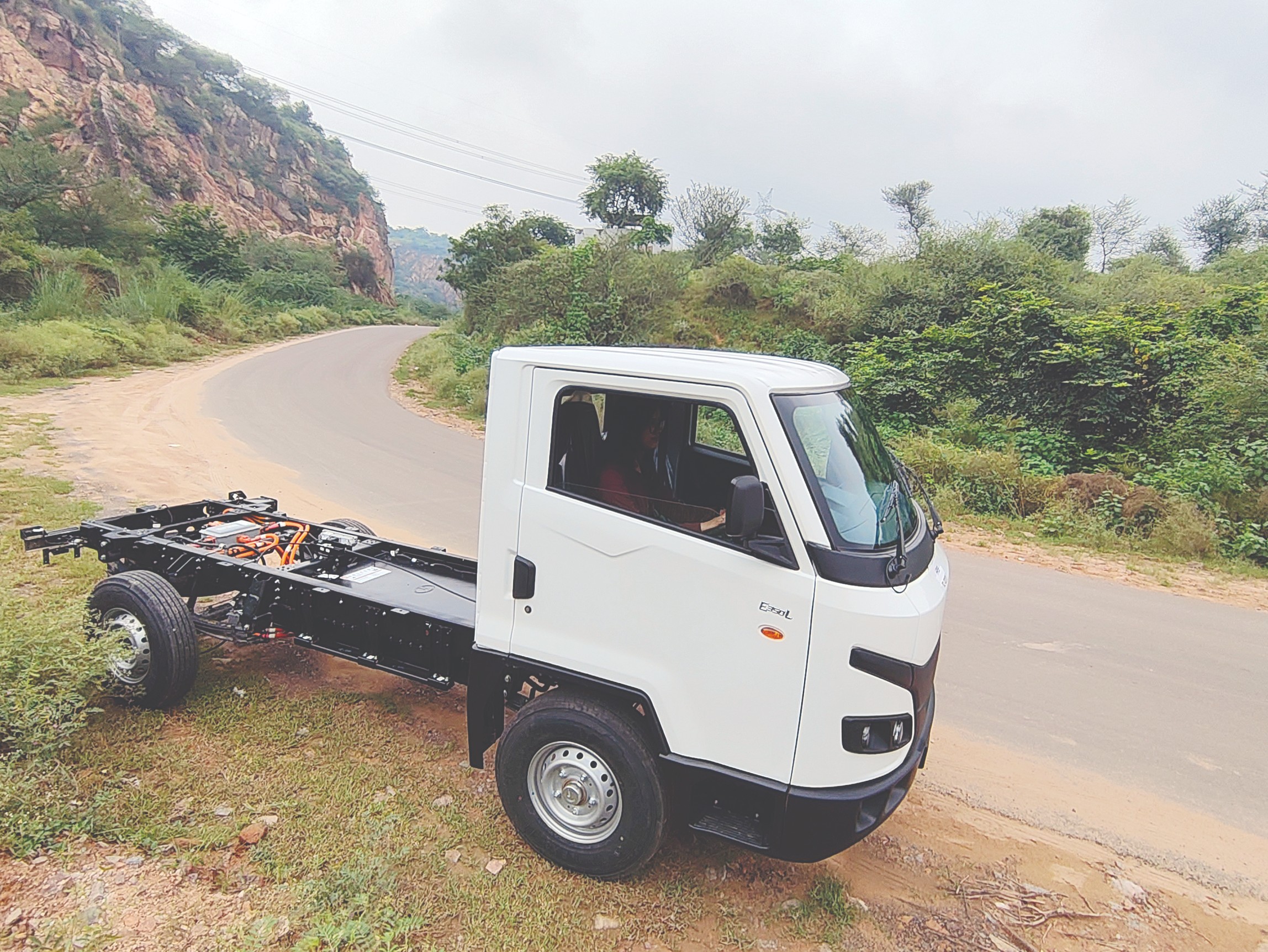
During our evaluation, we drove a basic chassis-spec test mule, Eviator 350L, which revealed the core driving dynamics and structural behaviour. The mule hinted at the advanced features, such as the infotainment display and app-based telematics stressed upon, as restricted to higher, production-ready trims. The base variant given to us though demonstrated clear intent to modernise the working environment for drivers in a bid to transform surface logistics as cleaner, quieter, and more productive. Montra offers the Eviator in multiple charger and trim configurations. Prices range from Rs. 15,87,948 for the 3.3 kW CBC (Chassis with Cabin) variant and Rs. 15,99,405 for the 7.4 kW CBC variant, to Rs. 16,15,614 for the 3.3 kW FSD (Fully Built Super Deck) variant and Rs. 16,27,071 for the 7.4 kW FSD model.
Exterior & Design
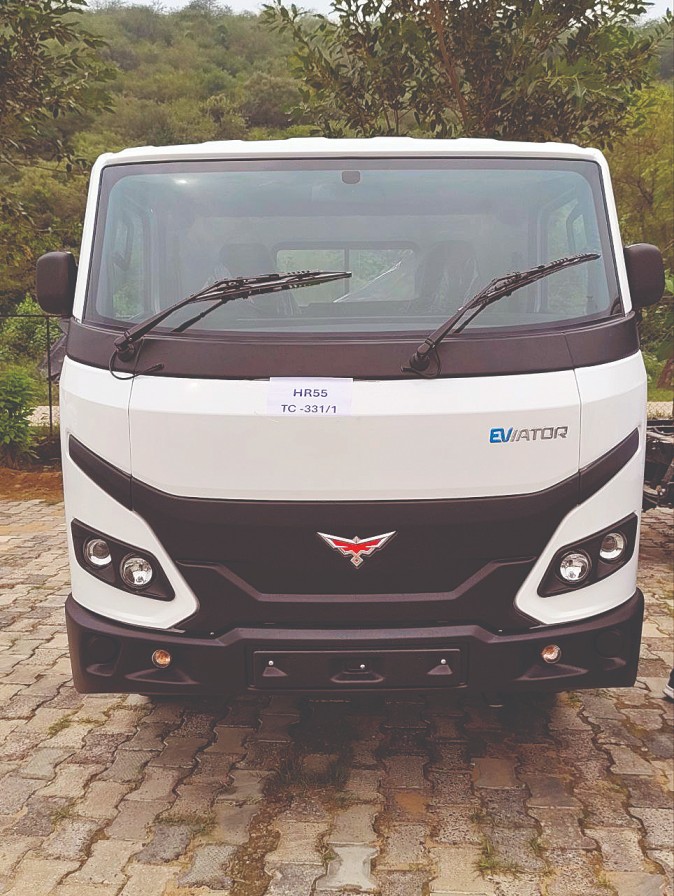
The Eviator adopts a contemporary exterior approach now being worked upon by the CV OEMs more aggressively. The front fascia brings an uncanny resemblance to an eagle-inspired grille, paired with LED headlamps and integrated DRLs. While styling has traditionally been a secondary consideration in this segment, today’s generation of owner-cum-drivers is increasingly aspirational, making modern design elements and a well-finished exterior more relevant than before. The lighting kit improves visibility in low-light conditions and contributes to energy efficiency, the company claims. Given the daylight drive, these claims remain to be validated.
Turn starboard and the wheelbase of 2677 mm comes into play. The attention is drawn to the claimed best-in-class 10.4 ft. loading deck with a tailgate. This deck challenges comparable models in the ballpark range of the eight–to nine-ft. range. Within the 3.49-tonne GVW, the Eviator reserves a 1.7-tonne payload. For businesses where cost per tonne per trip and payload volume determine profitability, this extended deck provides an immediate operational edge. The reduced trips enhance the truck’s economics even before considering its electric efficiency benefits over the ICE counterparts.
Interior and Driver Comfort
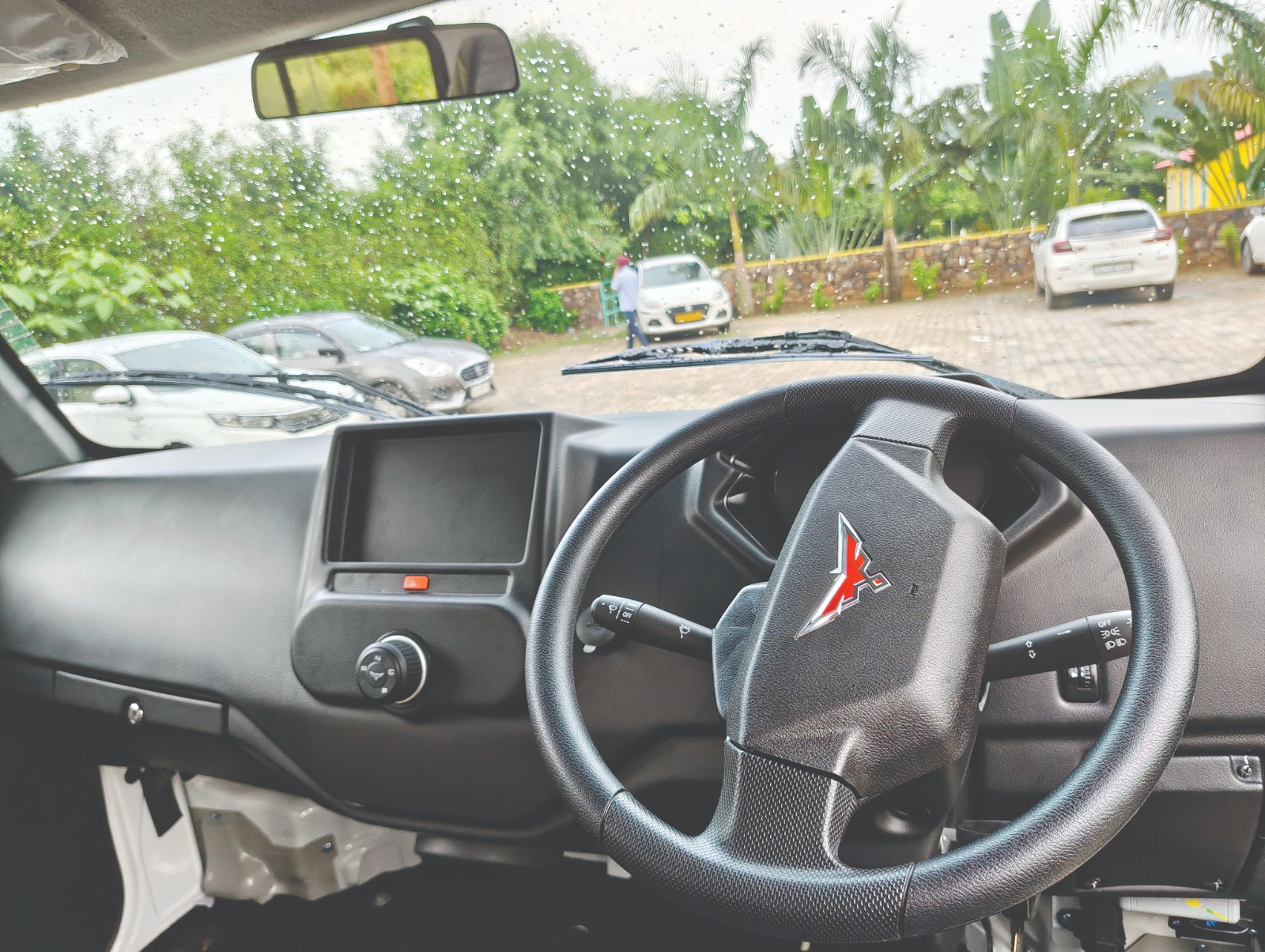
Stepping inside, the cabin features a layout that prioritises usability and accessibility. The dashboard layout places frequently used controls
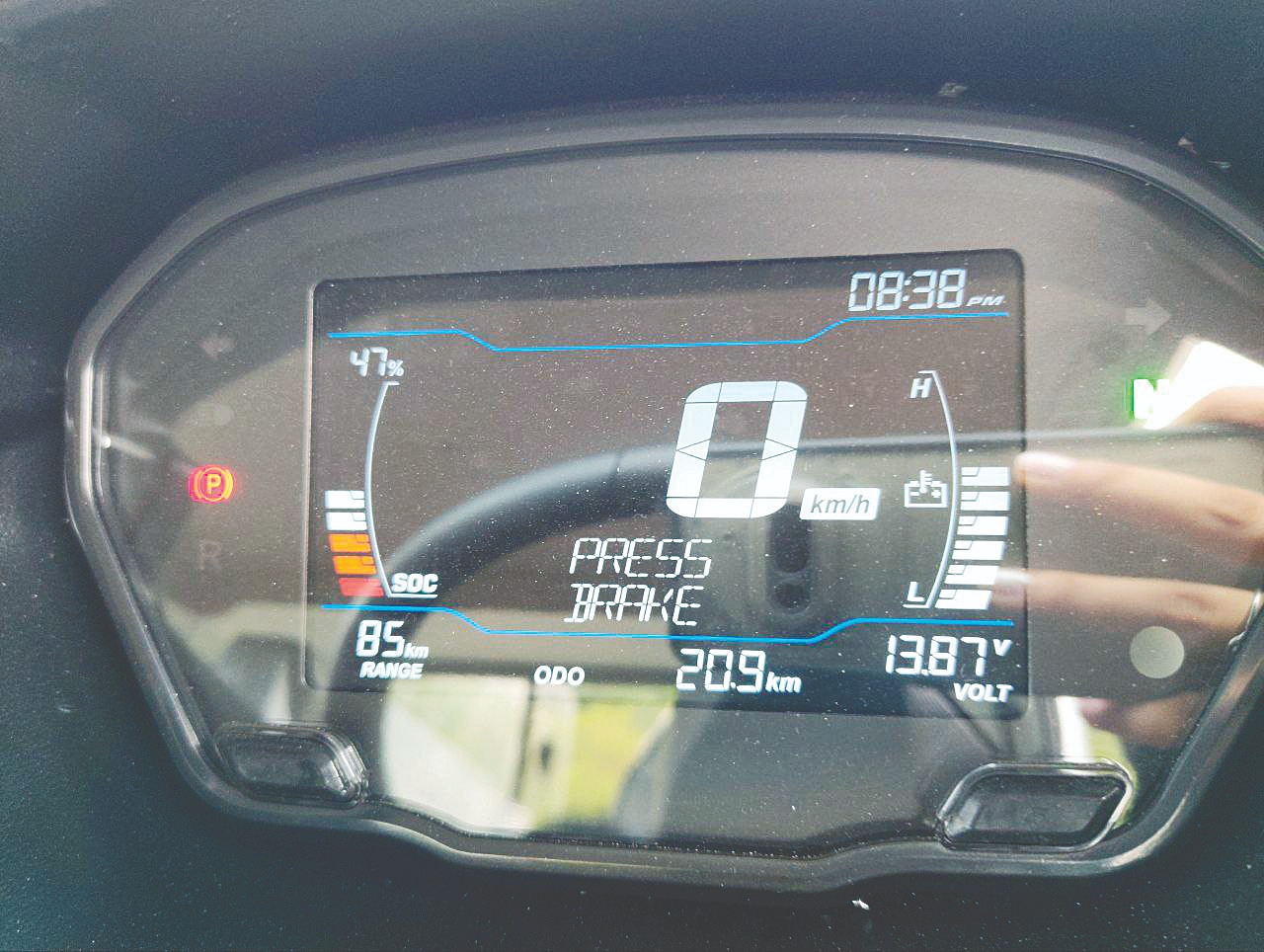
within natural reach, which we tested in greater detail during the drive. A smart digital instrument cluster displays essential driving data such as speed, battery SoC, range estimation and drive mode, in an easy-to-read, clear format. The angle of the display made it easy to read in broad daylight. Cubby holes dotted the dash for additions like the infotainment screen.. This indicates that the connected interface will be offered on higher trims or fully built production variants.
The vehicle also incorporates a walkthrough cabin in line with the available options, paving the way for a free-flowing movement and D+2 certified seating. It also aids in loading supervision or in high-turnover delivery environments. The driver’s seat is adjustable and includes a headrest with a recliner for comfort in extended shifts. A key advantage is the inclusion of electric power steering. In congested areas or while executing tight turns, the system reduces steering effort considerably, which we put to test. As an EV, the cabin NVH levels remain well insulated and let in just the apt hiss of the 80 kW PMSM motor.
Performance & Driving Dynamics
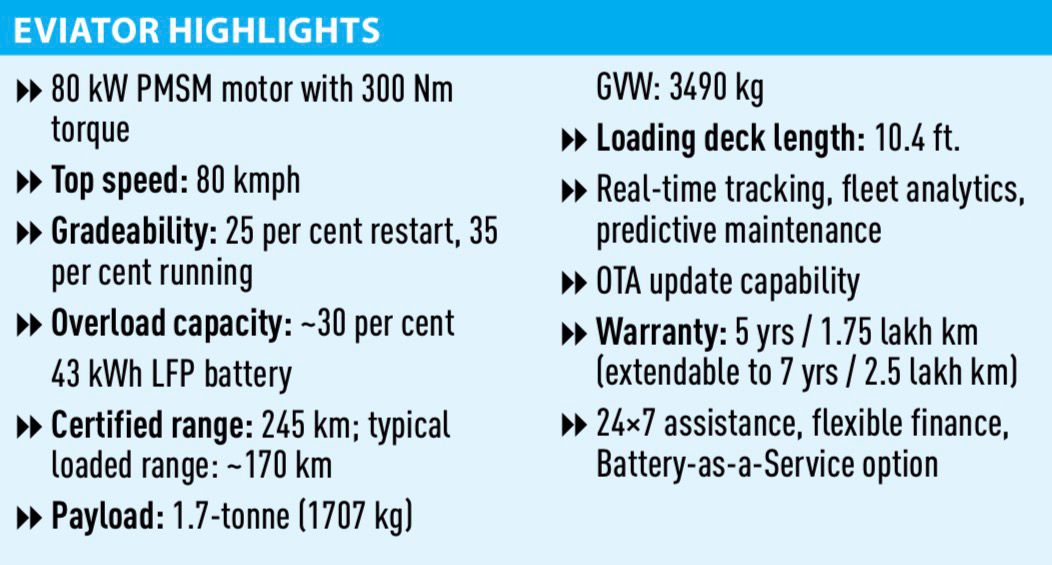
The Eviator is powered by a 43 kWh LFP battery pack, claimed to be the largest battery pack in the segment, paired to a Permanent Magnet Synchronous Motor (PMSM). The powertrain delivers 80 kW of peak power and 300 Nm of torque, placing the vehicle competitively within the SCV-pickup category. On the move, we put the LFP pack through its paces and the truck’s torque delivery was as expected from an EV. It is injected efficiently through the throttle curve until the motor maxes out. Initial acceleration is smooth and predictable, and the motor can be pushed to produce a linear output even under a laden state, as per the company’s claims. This was true in an unladen state. In a stop-and-go urban setting, this responsiveness helps with maintaining momentum without taxing the powertrain thanks to the BMS and the liquid cooling system integrated.
Build Quality, Chassis & Safety
The Eviator is built on a ladder chassis with a C-section design, a common structure known for durability under high-load applications. The configuration includes a rear E-axle and a front I-beam axle with a rated load bearing capacity of 1.7-tonne respectively. The suspension uses two-stage parabolic leaves, which are designed to balance comfort with load-carrying stability. During the drive evaluation, the setup handled typical road imperfections adequately, maintaining predictable body motion without excessive bounce even in an unladen state.

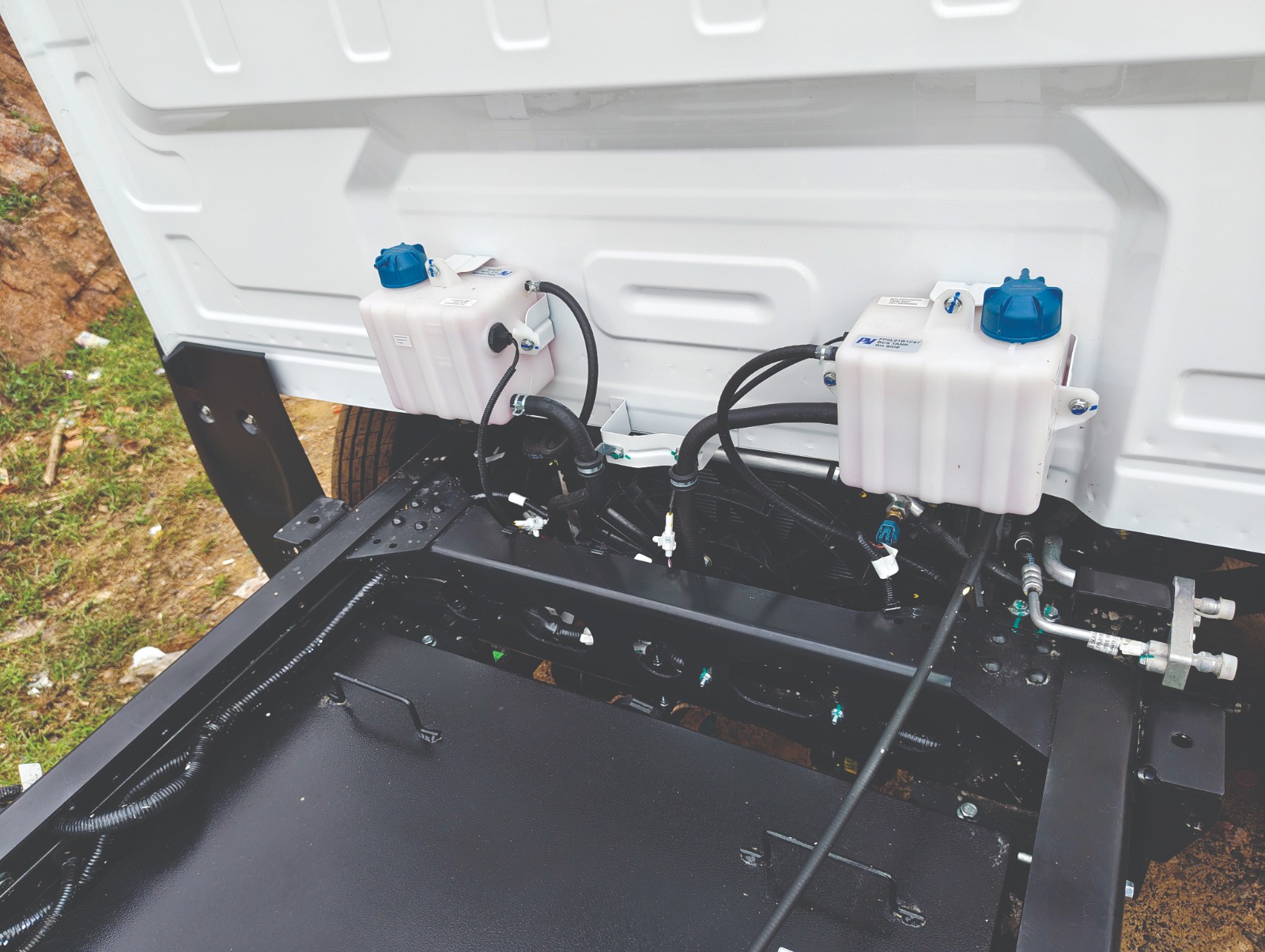
Safety is enhanced with the braking kit of front disc brakes, rear drum brakes linked back to the hill-hold assist, the latter of which is useful during city deliveries involving ramps or inclined parking areas and a welcome inclusion in the segment. The truck’s IP67-rated power electronics offer protection against dust and water ingress, which is relevant for operation during monsoons or in dusty industrial environments. Compliance with AIS 038 Phase 2 regulations supports its certification readiness and adherence to current safety norms.
The vehicle’s shell and suspension tuning allow it to retain stability with a full payload, as per claims. Montra claims the Eviator can achieve 25 per cent restart gradeability and 35 per cent running gradeability, figures that suggest suitability for moderate urban inclines and entry ramps to logistics hubs and complexes on either end of the spectrum. On the milder gradients encountered in the test route, the Eviator maintained composure and did not exhibit rollover/strain or drivetrain limitations.
The drive mode selector responds quickly, and switching between City and Power modes during the drive produced a noticeable difference in the pre-programmed throttle response. This is particularly useful when alternating between the modes or from an unladen to a laden state. The unladen test mule brakes produced a linear response, and the truck came to a smooth stop within what felt like a typical distance of 25–30 m for an SCV-pickup of this size. Although exact figures were not recorded, the consistency and control during braking inspired confidence for low- to mid-speed intra-city operations.
Range And Charging Capabilities
Range performance is a critical factor for commercial fleet operators. Montra lists the Eviator’s ARAI-certified range at 245 km. Under typical urban load conditions, the vehicle is expected to deliver a real-world range of around 170 km, depending on payload, driving style, route, and temperature. These figures enable the vehicle to complete a full day’s standard intra-city operations without requiring a mid-shift charge for many use cases. For operators with predictable routes and depot charging, this range can align well with existing fleet cycles.
Charging flexibility is another important operational factor. Eviator supports multiple charging modes: 3.3 kW AC home/slow charging, which takes around 10 hours for a full charge; 7.4 kW AC charging, which completes in approximately five hours; and 30 kW DC fast charging, which can recharge the battery from 20 per cent to 100 per cent in about one hour and 17 minutes. The vehicle is also compatible with CCS2 fast-charging infrastructure. This variety offers operators flexibility in choosing between overnight charging, faster depot-based charging, or interim top-ups. For fleets operating in two or three shifts, the availability of DC fast charging can help reduce downtime and increase daily utilisation.
Ownership considerations
Montra Electric offers a comprehensive set of support features aimed at reducing downtime and increasing operational predictability. The vehicle includes a five-year or 1.75 lakh km warranty, with an option to extend coverage to seven years or 2.5 lakh km. This duration aligns with typical commercial duty cycles and may help reduce long-term maintenance concerns for fleet owners.
Additional support includes 24×7 uptime service, roadside assistance, and flexible finance or leasing arrangements. Importantly, the company offers a Battery-as-a-Service (BaaS) model, which may allow buyers to reduce initial acquisition cost by separating battery ownership from vehicle ownership. For some operators, especially smaller fleets or first-time EV adopters, this may simplify the transition to electrified operations.
EVIATOR In The Making
The SCV-pickup segment is steadily pitting ICE- platforms to purpose-built electric architectures. Operators in e-commerce, FMCG, city logistics and regional distribution are demanding predictable daily range, lower TCO, and dependable performance consistency. While the EVIATOR is tested on road to be a significant challenger brand, the full-built road ready vehicle has a back story to tell. A walkthrough of the Montra Electric, Ponneri, Chennai facility helped join the dots on what makes the road-ready EVIATOR a compelling challenger brand.. The visit brought together senior leadership and plant personnel, offering a clear and structured view of the intent, validation depth and production discipline behind the SCV-pickup, EVIATOR.
CEO, Saju Nair outlined that the EVIATOR was shaped after mapping twenty-eight distinct duty cycles across the logistics landscape. For most operators in these clusters, the average utilisation lies between one hundred and two hundred kilometres a day. This range expectation influenced the choice of battery configuration, motor pairing and thermal strategy from the outset. The validation was approached with similar clarity. The EVIATOR fleet has collectively covered well over 12 lakh kilometres across coastal belts, high-temperature zones, dense urban routes and mixed-gradient regions. These cycles exposed the vehicle to real operating conditions and allowed the engineering teams to refine thermal management, control software and subsystem behaviour. As Nair explained, the production specification stands on demonstrated performance rather than assumed parameters.
Charging economics form a crucial part of the operating equation. For this category, home and depot charging remain the most cost-efficient, often keeping the running cost under two rupees a kilometre. According to Nair, a correctly specced battery covers the daily duty cycle without the added cost or logistical dependency associated with swapping infrastructure and this is factored in the integration on the shopfloor.

A key differentiator for the EVIATOR is its electric-first architecture. Rather than adapting an ICE-frame, Montra Electric opts for a clean-sheet design, enabling balanced weight distribution, optimised packaging and more efficient integration of high-voltage components. This approach avoids the compromises frequently seen in converted platforms, where weight, geometry and structural behaviour
may not align with electric powertrains. Market awareness around these differences has increased, and operators are now actively seeking platforms designed for EV use from inception.
Montra Electric’s presence spans major cities across the south, west and north, with expansion into central and eastern India planned. A growing share of repeat buyers indicates that the vehicle’s performance, driver training and early deployment support are translating into customer confidence. The Ponneri plant underpins this strategy. Designed for an annual capacity of 50,000 units, the facility currently operates at five to 10 per cent utilisation, offering substantial headroom as EV adoption increases. As Nair stated, the capacity was intentionally built ahead of demand to ensure stability when the segment scales.
Production Flow
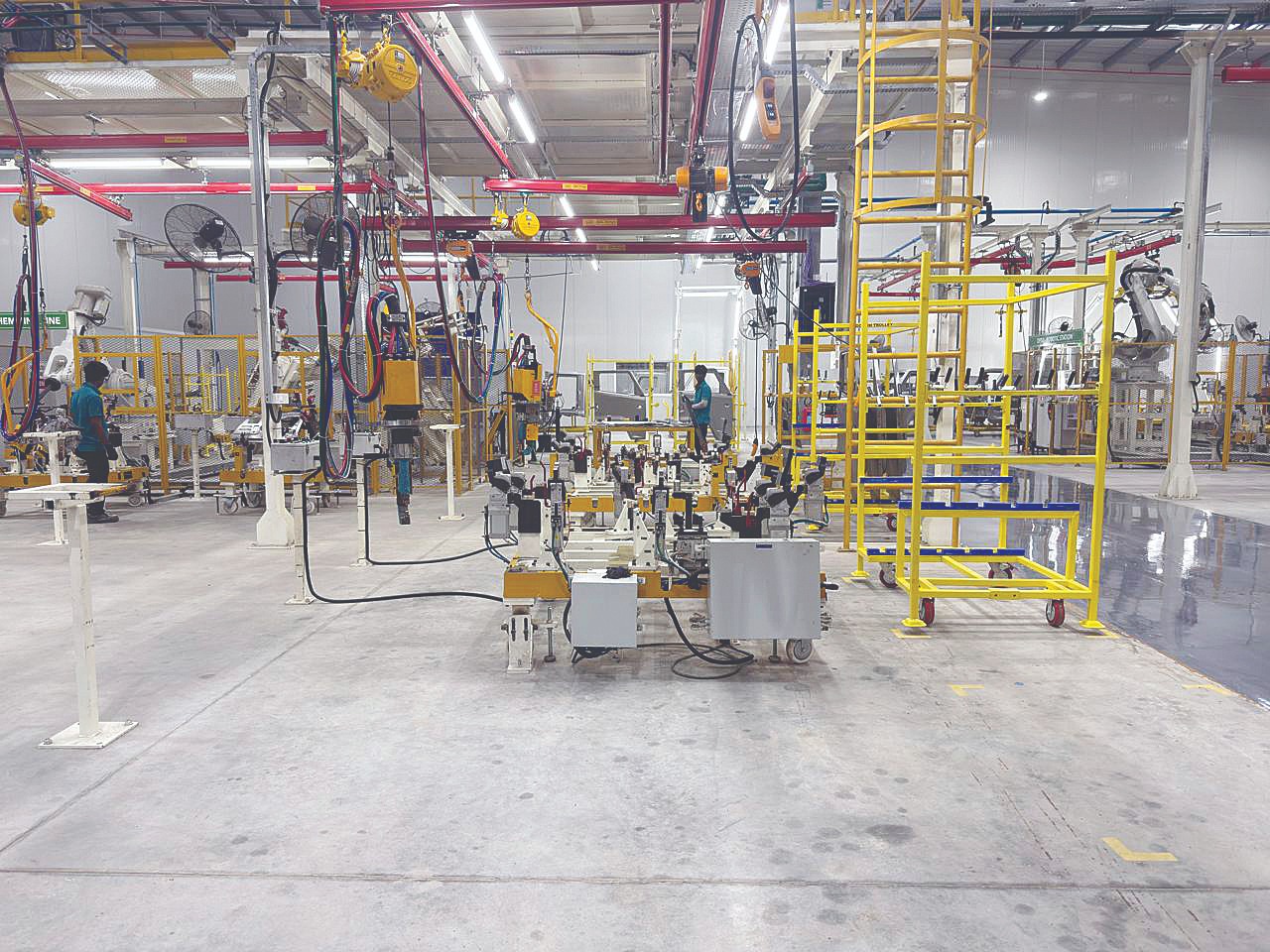
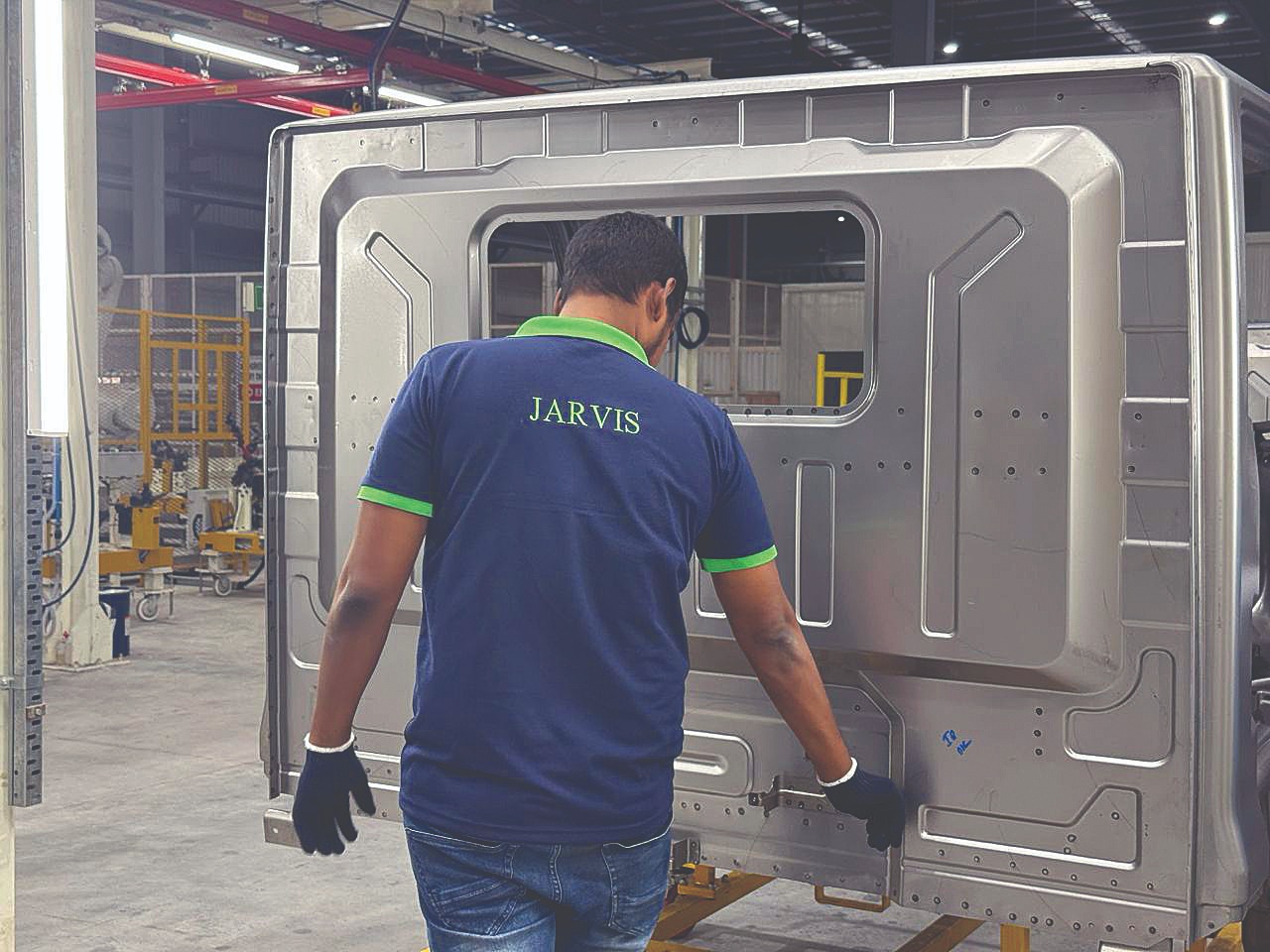
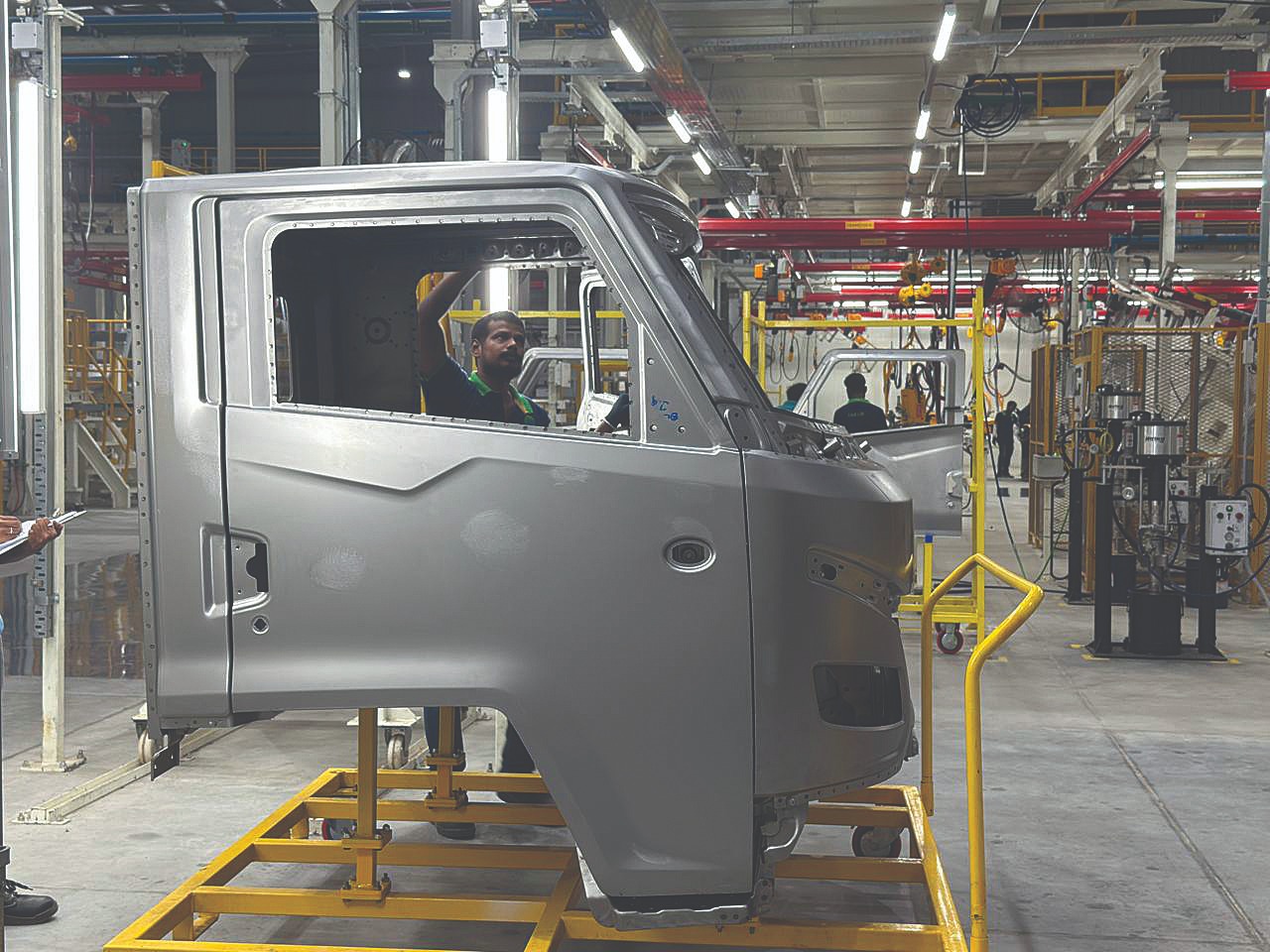
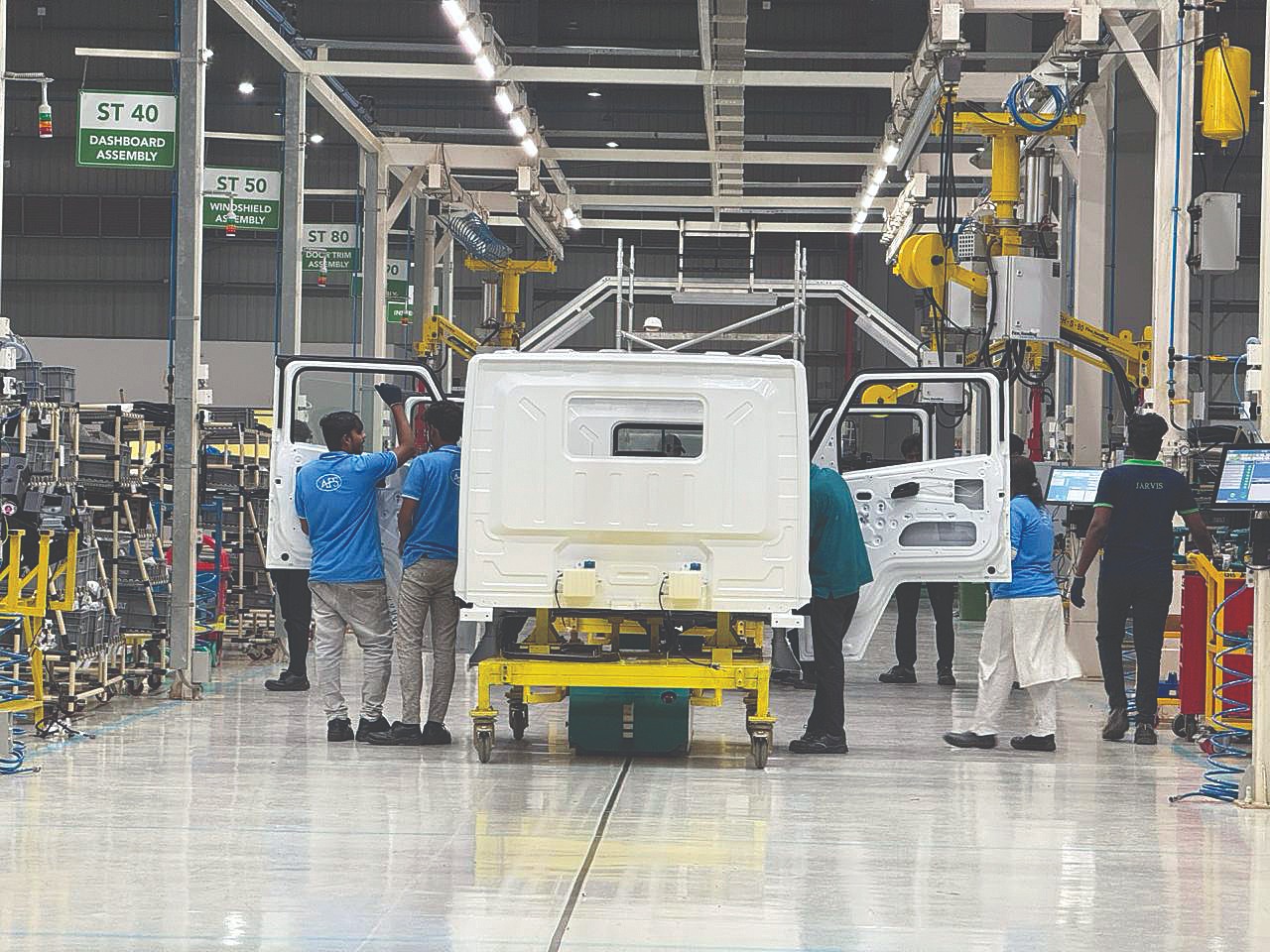
The plant walkthrough, led by Plant Head, Venkatas Subramanian, detailed a manufacturing sequence designed for consistency, modularity and scalability. The flow reflects EV-specific requirements around thermal routing, battery placement and high-voltage safety, it from conventional ICE assembly lines. The production journey begins in the robotic weld shop. Automated systems cut, align and weld the cabin frame with high repeatability. Structural joints, roof placement and side-panel alignment are robot-controlled, ensuring a uniform base structure. The completed cabin then moves to the paint shop.
Automated Paint Line
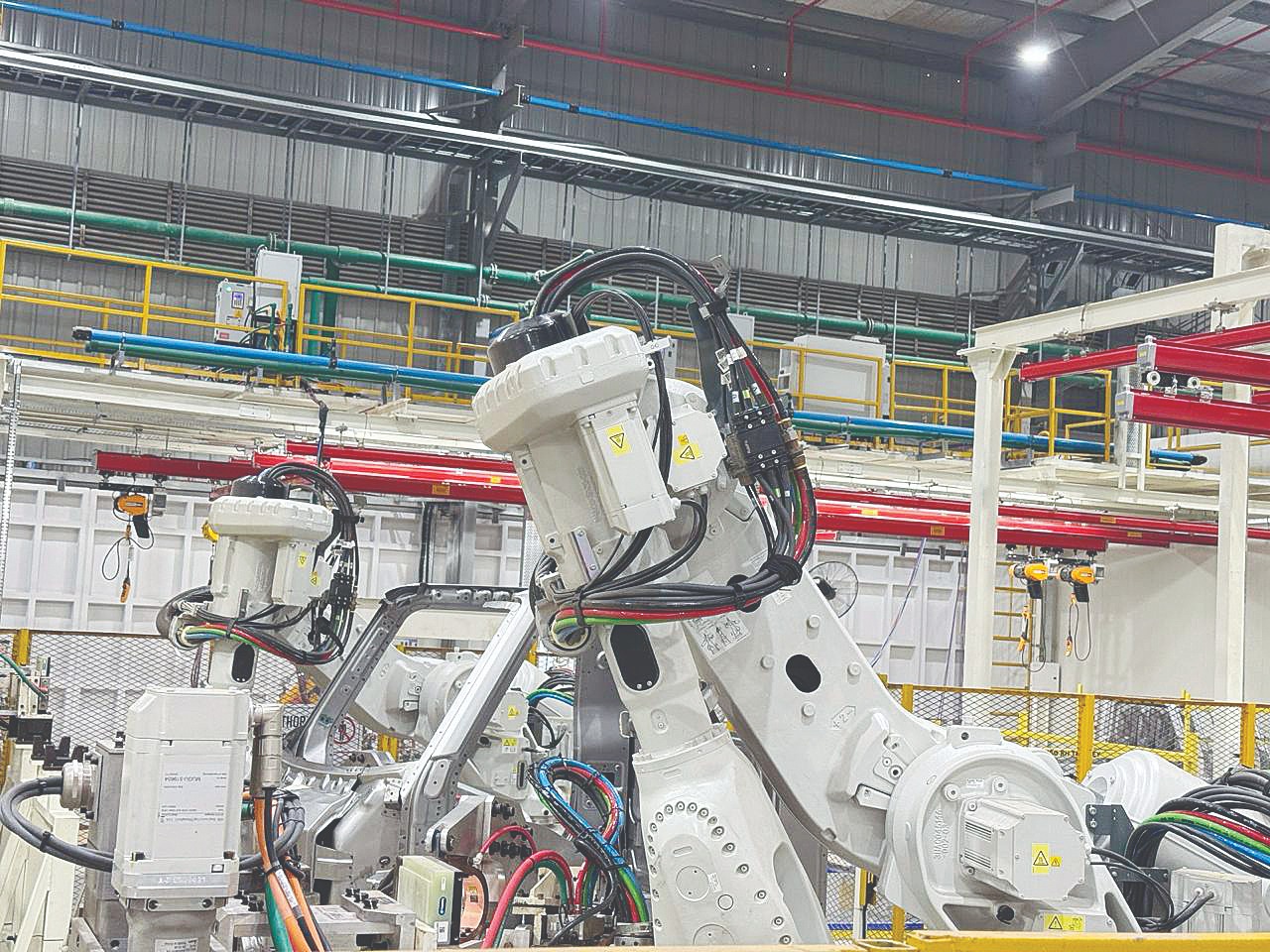
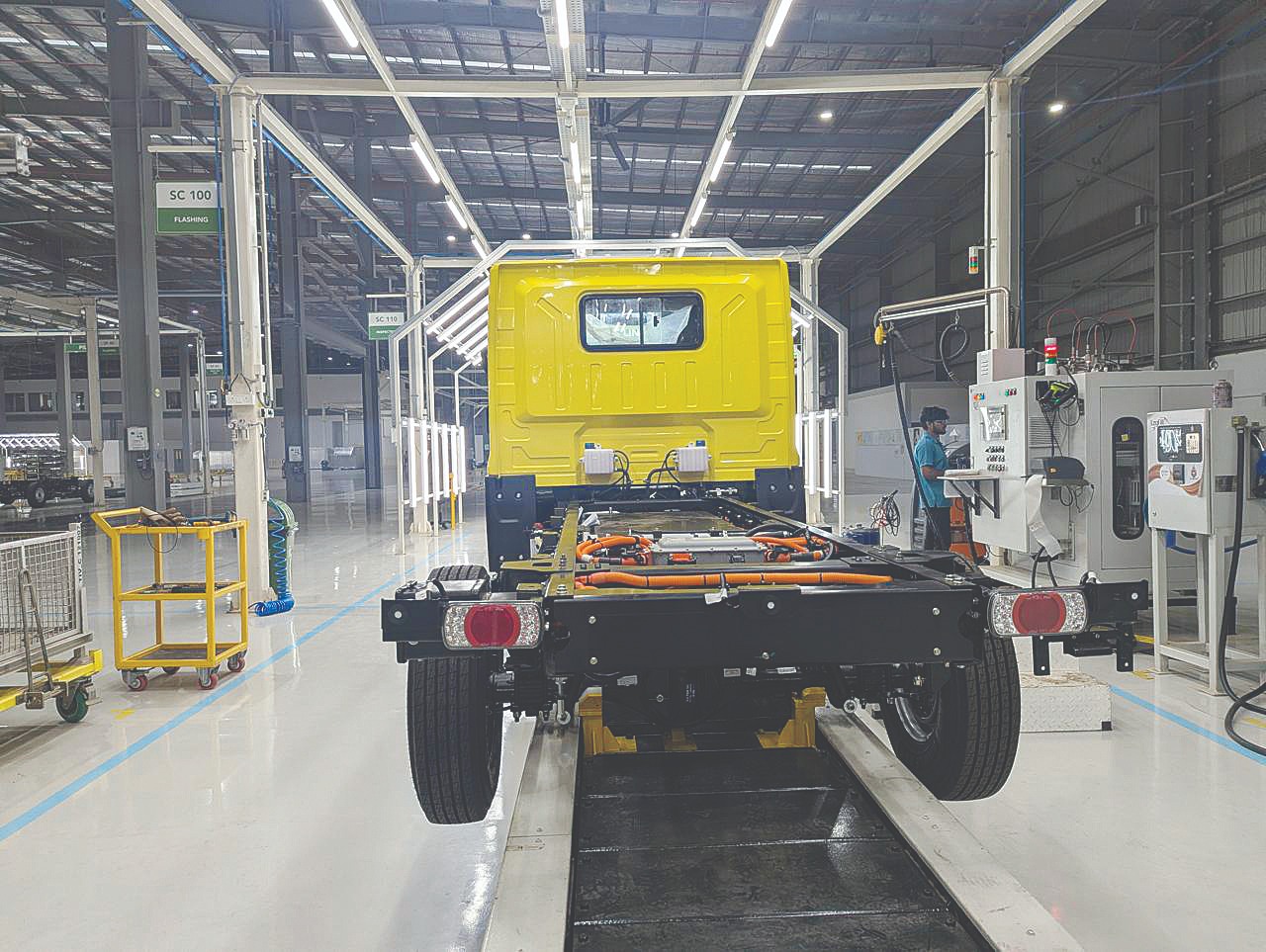
The paint zone is one of the plant’s most automated areas. More than eighty per cent of the paint process is automated, including the CED stage. The line incorporates idle-line energy-saving controls, which reduce consumption when the flow temporarily pauses using six-axis ABB make of robots sourced from ABB. A defining feature of the Ponneri facility is its pitless conveyor, extending nearly 83 metres across 12 stations. Each station is designed around a structured seven-metre workflow. Because the conveyor is surface-mounted, it can be dismantled and relocated within an estimated 15 days, allowing rapid layout adjustments as volumes increase.The painted cabin enters the trim zone, where brake lines, low-voltage harnesses, piping and interior wiring are installed. Montra Electric employs a lean part-feeding system, supplying components based on line triggers rather than bulk stocking. Only fast-moving items remain at the station.
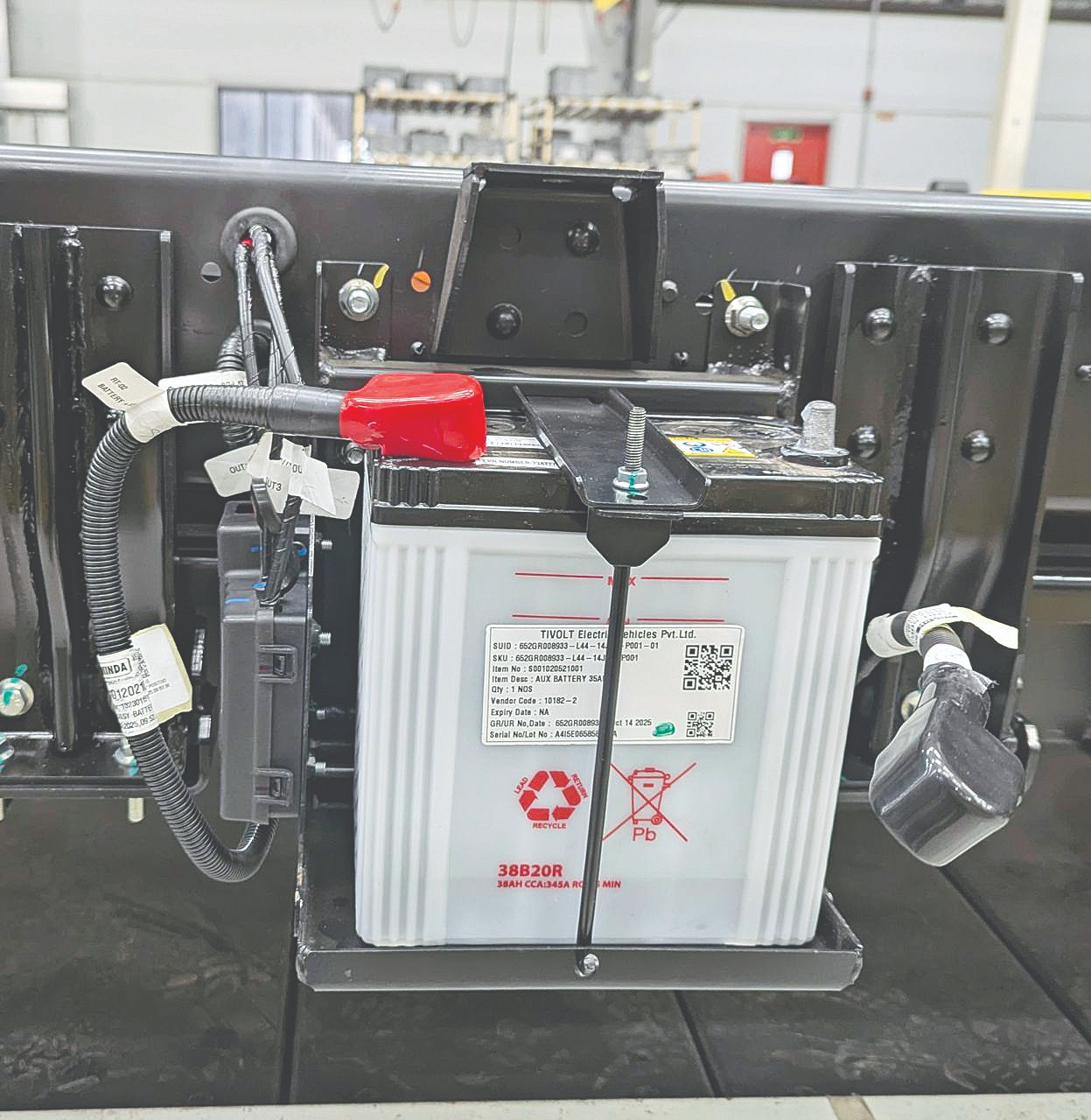
After preparatory harnessing and piping, the battery pack is mounted. Chassis integration follows, involving axle placement, differential mounting and steering assembly. Safety-critical joints are assembled using calibrated DC tools, which record torque values against the vehicle’s universal identification number.
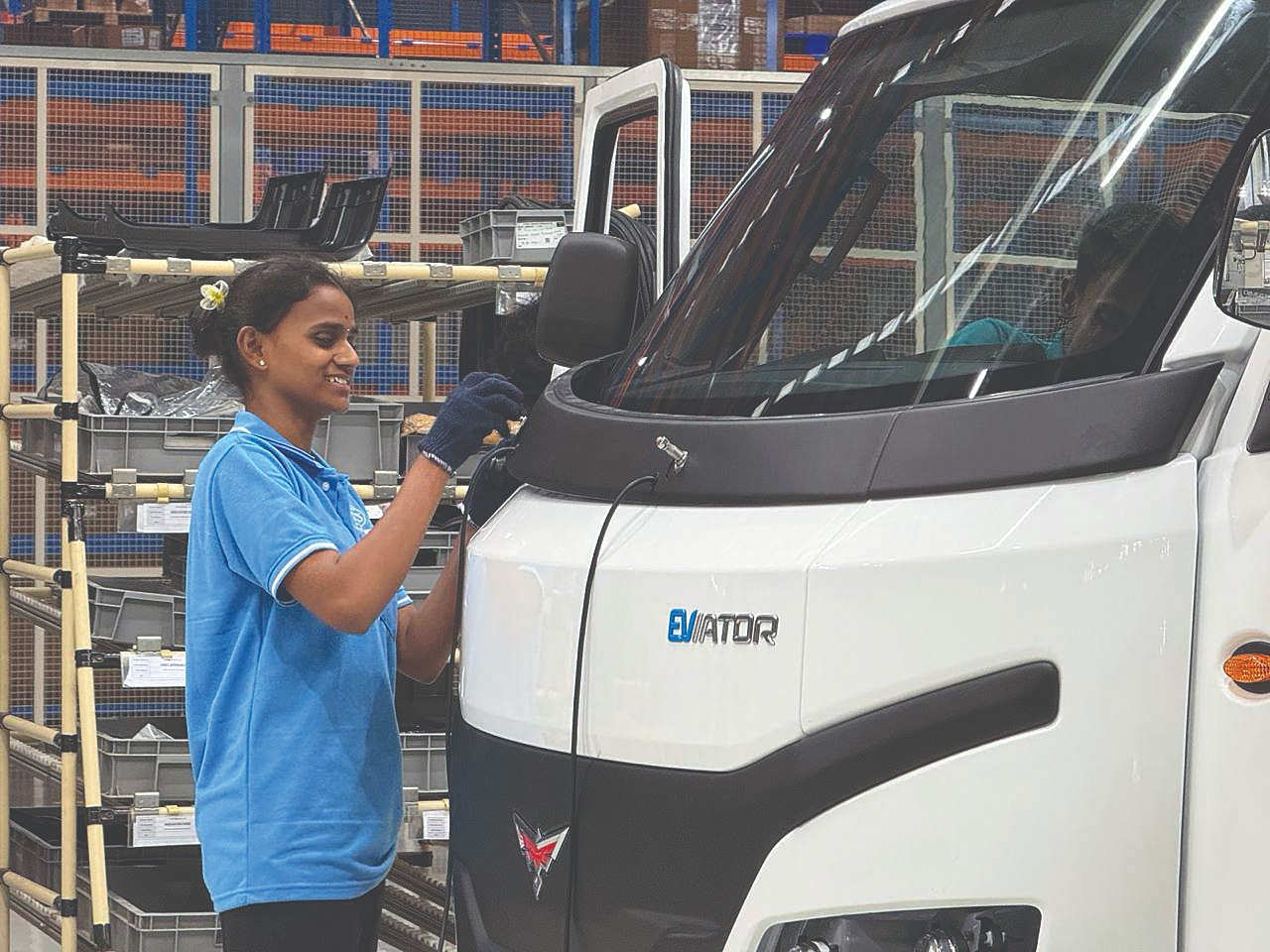
Windshield installation is handled by a dedicated robot, ensuring accurate adhesion. Interior fitment, including dashboard wiring, lighting modules and instrument clusters. It is carried out by trained teams to maintain precision and consistency. This process is followed by vacuum-based fluid filling, which ensures uniform distribution of coolant, brake fluid and nitrogen while reducing rework.
Verification, Testing & PDI
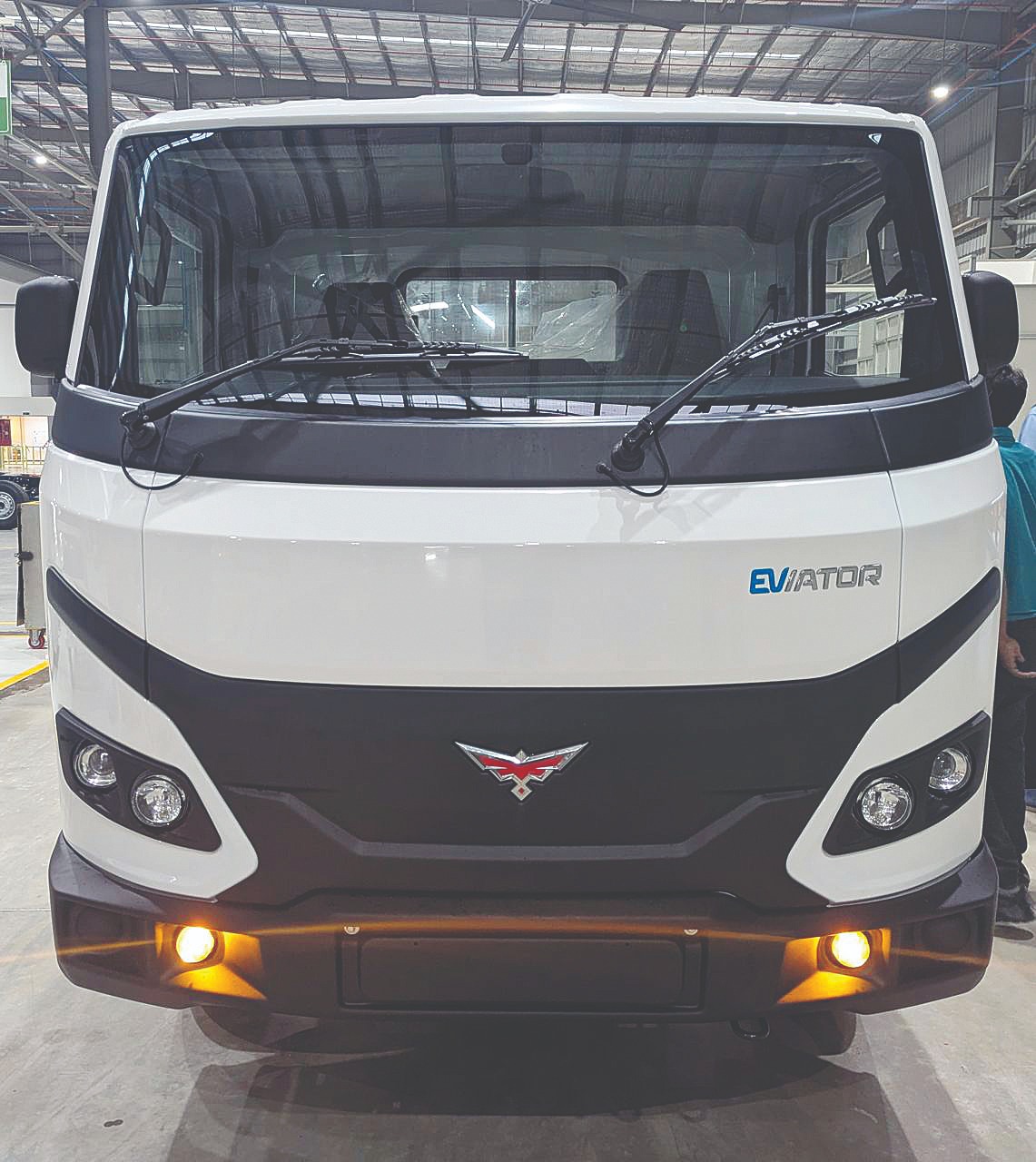
Every EVIATOR undergoes a structured verification sequence. A roller dynamometer test assesses drivetrain behaviour, torque delivery, and communication between modules. Digital wheel alignment ensures accurate geometry. Headlamp calibration validates spread and focus. A two-bar pressure shower test confirms cabin sealing. Pre-delivery inspection certifies the vehicle for dispatch. Each vehicle’s universal number logs operator details, torque records, timestamps and clearance at each station, providing complete traceability. The throughput from trim entry to pre-delivery readiness is about three hours. The line is engineered for a future TAT of approximately seven minutes per vehicle, once volumes scale.
Supply Chain, Battery Integration & Sustainability
Montra Electric aligned its supply base at the project’s inception, enabling predictable ramp-up as the segment matures. Battery support is drawn from two TI Clean Mobility facilities, one in Manesar for heavier commercial vehicles and another in Coimbatore for the small-commercial category through a sister entity. Regulatory compliance includes ARAI-certified crash testing of the cabin. Higher-spec EVIATOR variants will offer radar-based alerts, driver monitoring and exterior camera-assisted estimation. Sustainability is embedded into the Ponneri facility’s design. Between seventy-two and eighty per cent of the lighting is natural. The plant functions as a paperless factory in core areas, except for statutory requirements. The paint shop uses energy-efficient motors and idle-cut logic, while rooftop solar installation and recycled-water systems are planned as part of future scale-up.