

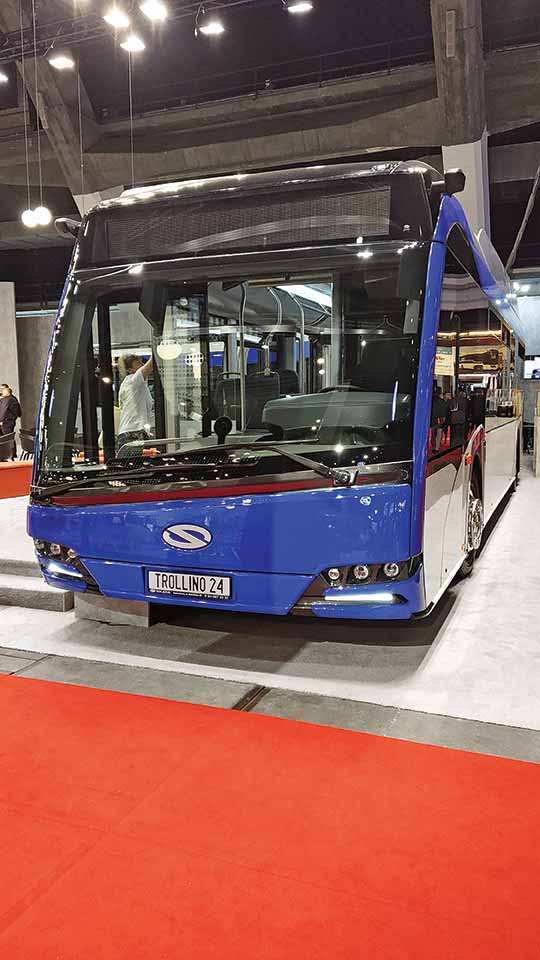
Differentiating itself as a mass provider of e-mobility solutions in Europe, Solaris displayed an interesting product line-up. Into alternative drivelines, constituting an estimated 47 per cent share of its product mix, the bus and coach maker, presented three emission-free vehicles- the Urbino 12 hydrogen, the Urbino 18 electric and the battery trolleybus Trollino 24. Of the belief that the new diesel engines are efficient and will continue to play a role in the future, Solaris in the form of the Trollino 24-metre bus presented as a niche solution for transportation business models like the Bus Rapid Transport (BRT). Expected to play a key role, the bus measures 24.7 m in length, 2.55 m in width and 3.45 m in height. It has a front overhang of 2.7 m and a rear overhang of 2.75 m. Capable of ferrying 185 passengers (up to a total of 215), it is electronically articulated. Powered by 2×160 kW traction motors that draw power from a 58 kWh battery pack, the trolleybus adds an interesting angle to the viability and functionality of a BRT system. Aimed at BRT system as well, Solaris showcased an 18-metre Solaris Urbino electric bus which can ferry 120 passengers ( up to a total of 145). Premiering at the UITP Global Public Transport Summit 2019 at Stockholm, Sweden, the Solaris Urbino 12 hydrogen demonstrated the progress of fuel-cell vehicles beyond prototypes. Capable of ferrying 93 passengers (up to a total of 98), the bus relies on an electric drive axle with two integrated motors of 125 kW each. The drive motors draw their power from hydrogen stored in five-, 312-litres, Type-Four composite hydrogen tanks placed on the roof of the bus. Hydrogen passes through the 70 kW fuel-cell stack to generate electricity. The Solaris High Power battery packs store the energy recovered and backup the fuel cell in case the demand for energy is high.